sales@hu-steel.com
 English
 Español
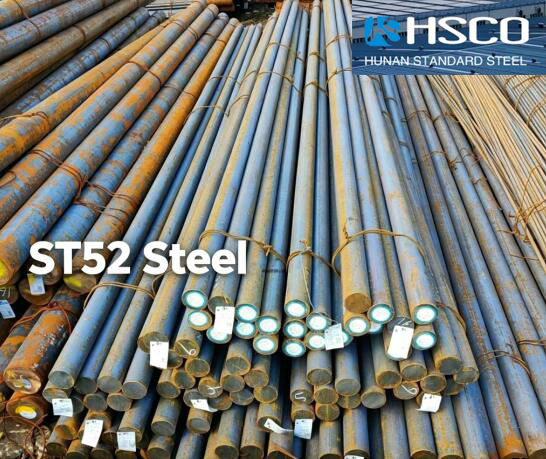
The ST52 material is a non-alloy steel which is considered as a common structural steel, originating from the German standard DIN 17100. This steel is mainly characterized by its tensile strength and yield point. Used in civil construction, underground engineering, bridge construction, marine structures, container manufacturing, and automotive and machine building. It remains one of the most common structural steel grades worldwide.
The ST52-3 designation follows the old German DIN standard naming system: "St" stands for Steel (Stahl) , "52" represents the minimum yield strength of 52 kgf/mm² (approximately 510 MPa, corresponding to a minimum yield strength of ≥355 MPa for thickness ≤16mm) , and "3" indicates the quality level (ensuring certain impact toughness requirements).
⚠️ Important Note: DIN 17100 was officially withdrawn in 2004 and replaced by the European standard EN 10025. The direct equivalent grade for ST52 in the modern European standard is S355J2 (EN 10025-2). For hollow sections (square tubes, rectangular tubes, round tubes), the equivalent grade is S355J2H (EN 10210 / EN 10219).
| Element | Content (Max) | Function |
|---|---|---|
| Carbon (C) | ≤ 0.22% | Controls weldability; low content prevents weld hardening |
| Silicon (Si) | ≤ 0.55% | Deoxidizer; strengthens ferrite |
| Manganese (Mn) | ≤ 1.60% | Solid-solution strengthening; improves material strength |
| Phosphorus (P) | ≤ 0.040% | Strictly controlled to ensure plasticity |
| Sulfur (S) | ≤ 0.040% | Strictly controlled to improve toughness |
| Copper (Cu) | ≤ 0.55% | Trace alloying element |
| Nitrogen (N) | ≤ 0.012% | Grain refinement control |
ST52 is produced as a fully killed steel with fine grain treatment, ensuring consistent mechanical properties across different thicknesses.
| Thickness Range (mm) | Yield Strength (MPa) |
|---|---|
| ≤ 16 mm | ≥ 355 |
| 16 – 40 mm | ≥ 345 |
| 40 – 63 mm | ≥ 335 |
| 63 – 80 mm | ≥ 325 |
| 80 – 100 mm | ≥ 315 |
Data source: DIN 17100 / EN 10025 standards
| Property | Value | Notes |
|---|---|---|
| Tensile Strength | 490 – 630 MPa | For all thickness ranges |
| Elongation (A) | ≥ 22% | Longitudinal test specimen |
| Impact Energy (KV) | 27 J @ 20°C | DIN 17100 standard requirement |
| Impact Energy (KV) | 27 J @ -20°C | Corresponds to S355J2 requirement |
Compared to ordinary structural steel ST37 (yield strength 235 MPa), ST52 offers a strength increase of over 50% . This allows for lighter sections under the same load, thus reducing structural weight and material costs.
| Standard System | Equivalent Grade | Application |
|---|---|---|
| European (EN 10025-2) | S355J2 | Plates, sections, general structures |
| European (EN 10210) | S355J2H | Hot-finished hollow sections (SHS, RHS, CHS) |
| European (EN 10219) | S355J2H | Cold-formed hollow sections |
| Chinese (GB/T 1591) | Q355B | Low-alloy high-strength structural steel |
| American (ASTM) | A572 Gr.50 | High-strength low-alloy structural steel |
| Japanese (JIS) | SM490YA | Rolled steel for welded structures |
1. Excellent Weldability
● Low carbon content (≤0.22%) provides excellent weldability for all common welding processes (arc welding, MIG, TIG, SAW, etc.)
● For thickness ≤ 20mm: No preheating required when ambient temperature ≥5°C
● For thickness > 20mm: Preheat 50–100°C recommended; use low-hydrogen electrodes
● Post-Weld Heat Treatment (PWHT): Generally not required, except for heavy sections or critical applications
2. Superior Cold Formability
ST52 offers excellent cold formability for bending, flanging, stamping, and similar operations without cracking.
3. High Cost-Effectiveness
ST52 provides 30-40% material cost savings compared to medium-carbon alloy steels, while delivering sufficient strength and toughness.
4. Good Fatigue and Corrosion Resistance
The optimized micro-alloy composition provides better fatigue resistance under alternating loads and can form a dense oxide film to improve corrosion resistance.
ST52 material is available in various product forms to meet a wide range of applications, from light structures to heavy engineering.
| Product Type | Production Process | Size Range | Applicable Standard |
|---|---|---|---|
| Seamless Steel Pipe | Hot-rolled / Cold-drawn | OD 10.3 – 660 mm | DIN 1629 / DIN 2448 |
| ERW Steel Pipe | High-frequency welding | OD 21.3 – 660 mm | DIN 2458 |
| LSAW Steel Pipe | Longitudinal SAW | OD 406 – 1219 mm | Custom |
| Square / Rectangular Tube | Cold-formed | Custom dimensions | EN 10219 / EN 10210 |
| Steel Plate | Hot-rolled / Controlled rolling | Thickness 8 – 100 mm | DIN 1543 |
Dimensional Tolerances (per DIN 1629/2448):
● Outer Diameter: ±1%
● Wall Thickness: ±10%
● Straightness: ≤ 1.5 mm/m
● Length: 3 – 12 m (custom up to 18 m)
Surface Finishes: Black (with mill scale), galvanized, painted, etc.
Thanks to its excellent combination of properties, ST52 is widely used across the following industries:
1. Building & Infrastructure
Steel structure frames, bridge support structures
Tower crane structural components, municipal pipe supports
Scaffolding systems
2. Machinery Manufacturing
Equipment frames, medium-duty drive shafts
Gear blanks, pressure vessel shells
Construction machinery undercarriage components
Crane booms
3. Fluid Conveyance Systems
Medium-to-high pressure water and air pipelines
Oil and natural gas transmission pipelines
Chemical industry medium-pressure fluid conveyance (non-corrosive media, ≤10MPa)
4. Automotive & Agricultural Machinery
Commercial vehicle frames, agricultural machinery chassis
Trailer load-bearing structures, automotive bumper skeletons
5. Shipbuilding
Hull structural components (subject to certification)
6. General Structures
Hardware and mechanical structural components
Imported equipment localization replacement parts
Large equipment auxiliary structural components
⚠️ Not Recommended For: High-temperature service above 300°C, corrosive environments without additional protection, or cryogenic (ultra-low temperature) applications.
ST52 products are typically supplied with the following quality documentation:
● EN 10204 Type 3.1 Material Test Certificate (heat traceable)
● Dimensional Inspection Report
● DIN 17100 / DIN 1629 / DIN 2448 Compliance Certificate
● NDT Reports (if applicable)
△ Optional Third-Party Inspection: SGS, BV, LR, TÜV, etc.
Q1: What is the difference between ST52 and S355J2?
ST52-3 is the original grade under the now-withdrawn DIN 17100 standard. S355J2 is its direct equivalent under the current EN 10025-2 standard. Their chemical composition and mechanical properties are essentially identical, but S355J2 is the current, compliant grade for the European market.
Q2: What is the difference between ST52 and ST37?
ST52 has a much higher yield strength (355 MPa) compared to ST37 (235 MPa). ST52 is considered a "higher-grade" steel with stricter chemical composition control, while ST37 is a general-purpose structural steel.
Q3: Can ST52 be used for pressure vessels?
Yes, for non-critical, ambient-temperature pressure applications (water, air, oil). For pressure applications governed by EN 13445 or ASME B31.3, P355N (EN 10216-1) is recommended as it has stricter requirements.
Q4: What is the impact test temperature for ST52?
DIN 17100 requires 27J @ 20°C. For -20°C impact energy guarantee, you must specify the S355J2 requirement.
Q5: What is the equivalent grade for ST52 square/rectangular tubes?
S355J2H (EN 10210 for hot-finished / EN 10219 for cold-formed).
Q6: What should I consider when purchasing ST52?
1. Confirm impact grade: JR (room temperature) or J2 (-20°C)
2. Confirm product form: seamless, welded, square/rectangular tube, or plate
3. Confirm standard: acceptance of S355J2/S355J2H equivalent
ST52 material (and its modern equivalent S355J2H) is a workhorse material in the global structural engineering field, thanks to its high strength, excellent weldability, good cold formability, and outstanding cost-effectiveness.
▶ Need ST52 / S355J2H square tubes, rectangular tubes, or round pipes? [View our HSS product specifications and inventory →]
▶ Have a specific project requirement or technical question? [Contact us for a selection consultation and quote →]
Read more:
● Steel Hollow Sections: What are HSS, SHS, RHS, and CHS?
● EN 10219 S355J2H Square Hollow Section Specification
Related information
Copyright @2017 Hunan Standard Steel Co.,Ltd and Husteel Industry Group All Rights Reserved