sales@hu-steel.com
 English
 Español
Oil is now the world's most important energy, its use is very extensive, a lot of equipment need to use oil can be normal operation. For example, we often use cars, aircraft, generators and so on. If there is no oil, then our life will be a very big change. So now, oil drilling has been carried out in the uninterrupted. In the oil drilling time, thick-walled seamless steel pipe with this material is widely used.
Why are thick-walled seamless steel pipes chosen for oil drilling?
In oil drilling, choosing thick-walled seamless steel pipes to manufacture drill pipes and some critical casing pipe is an inevitable choice for coping with extreme working conditions.
Core reason:
During drilling, the drill string, thousands of meters long, acts like a high-speed rotating, suspended "steel whip," bearing the superposition and cyclic action of five basic loads: tension, compression, torsion, bending, and internal and external pressure. Thick-walled seamless steel pipes are the only solution that can stably withstand this complex load.
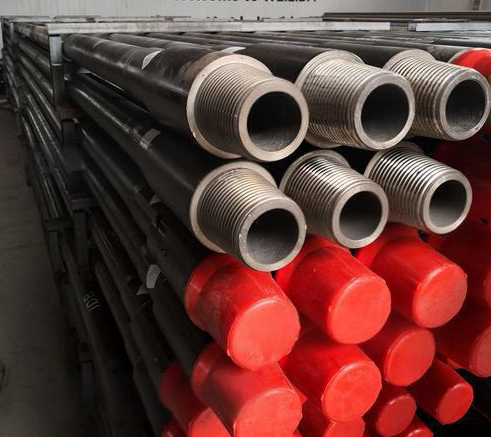
Seamless steel pipes have a uniform and complete overall structure, with consistent strength and toughness along the circumference, stable resistance to external pressure, and no weak points in the welds, avoiding the fatal risk of welds becoming the starting point for cracking under extremely high torsional stress.
2. Advantages of thick-wall design
a. High tensile strength: The greater wall thickness provides a larger cross-sectional area, capable of suspending the weight of a longer drill string (up to hundreds of tons), preventing the drill pipe from breaking.
b. High Torsional Strength: Thicker seamless pipe walls significantly improve shear resistance, enabling the transmission of enormous torques (up to tens of thousands of Newton-meters) applied by the drill rig rotary table to drive the drill bit through rock.
c. Resistance to Crushing and External Pressure: Thick-walled seamless pipes can withstand the immense confining pressure of formations thousands of meters deep, preventing the drill pipe from being crushed (crushed) within the wellbore.
d. Resistance to Internal Pressure: During high-pressure drilling fluid circulation, the thick walls prevent internal bursting.
e. Fatigue and Bending Resistance: Thick-walled seamless pipes provide higher stiffness, reducing deformation in curved wellbores; the thicker material also delays the initiation and propagation of fatigue cracks caused by alternating stress.
Of course, for drilling pipes, thicker is not always better; a rational choice must be made by balancing costs.
While meeting the above strength requirements, drill pipe design also pursues "high strength and lightweight," as the drill pipe's own weight is also a major source of load. Engineers need to find the optimal solution between "strength redundancy" and "cost-effectiveness."
1. Design Selection: By calculating the minimum safe strength required for a specific well depth, well type, and expected torque, the minimum steel grade and minimum wall thickness combination that meets the requirements is determined in reverse.
2. Economic Selection: Generally, a "high steel grade + thin wall" (e.g., S135 steel grade) approach is more economical than a "low steel grade + thick wall" approach because it replaces more steel weight with better material properties, reducing overall cost and rig load. However, when steel grades reach their limits (e.g., V150), it is still necessary to increase wall thickness to meet the requirements of ultra-deep wells.
Why not choose other types of steel pipe?
Welded pipe: Exists longitudinal welds, which are vulnerable areas for fatigue and fracture, unable to withstand the complex alternating loads in drilling, posing a very high risk.
Thin-walled pipe: Insufficient resistance to crushing and bending, highly prone to instability in deep wells.
Cast or forged solid bars: Too heavy, lack the hollow flow channel function for conveying drilling fluid, and are uneconomical.
Read more: Drill pipe corrosion fatigue fracture and stress corrosion fracture
Related information
Copyright @2017 Hunan Standard Steel Co.,Ltd and Husteel Industry Group All Rights Reserved