sales@hu-steel.com
 English
 Español
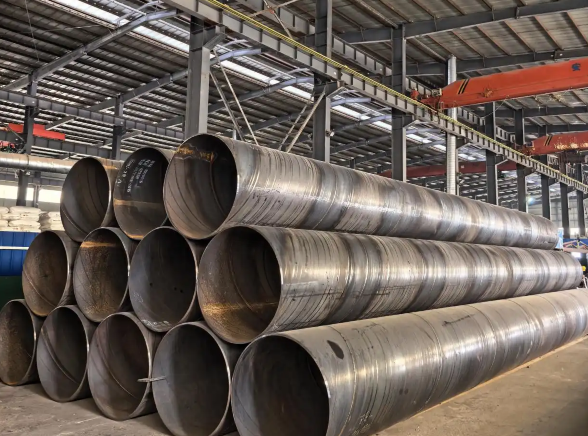
Spiral welded pipes (SSAW) are widely used in oil and gas transmission, water supply, structural piling, and other critical applications. Poor-quality pipes can lead to leakage, fracture, and shortened service life, especially in high-pressure and corrosive environments. For buyers, knowing how to identify quality before shipment and upon receipt is essential to avoid costly project failures.
For custom orders, inspection is typically carried out at the factory before shipment. A third-party inspector (SGS, BV, TUV) may be appointed for large or critical orders.
1. Surface Appearance
Inspect the pipe surface for pockmarks, folding, scratches, and cracks. A quality pipe should have a smooth, uniform surface without visible defects. Deep scratches and folding can reduce wall thickness and strength.
| Parameter | Typical Requirement | Notes |
|---|---|---|
| Outer Diameter (Pipe Body) | ±0.5% D to ±1.0% D | Varies by standard and pipe size |
| Outer Diameter (Pipe End) | ±0.5% D or ±1.6 mm | Whichever is smaller |
| Wall Thickness | +20% t / -0% t (t < 15 mm) | Asymmetric tolerance per API 5L |
| Ellipticity (Pipe End) | ≤0.5% D to ≤1.0% D | Stricter than pipe body |
| Straightness | ≤0.2% × length | General requirement |
| Local Straightness (Pipe End) | ≤4.0 mm in 1 m | Additional requirement |
| Pipe End Bevel | 30° to 35° | Per API 5L / GB/T 9711 |
| Blunt Edge | 1.6 ± 0.8 mm | Typical value |
4. Pipe End Machining
Inspect the pipe ends for proper bevel angle, blunt edge, and end face verticality. Poorly machined ends can cause welding problems during installation. The bevel face should be smooth and free from burrs.
5. Marking & Traceability
Each pipe should be clearly marked with manufacturer, specification, steel grade, heat number, and standard. This ensures traceability from raw material to finished pipe.
6. Certificates & Test Reports
Request the mill test certificate (MTC), hydrostatic test report, and NDT reports. These documents confirm the pipe meets the required standards. For X65 steel and above steel grades, additional documents may include HIC and SSCC test reports.
Hydrostatic Test Formula:
P = 2ST/D
Where:
P = test pressure (MPa)
S = test stress (MPa), typically 60% of the yield value specified in the steel strip standard
T = wall thickness (mm)
D = outer diameter (mm)
For stock orders or after delivery, inspection is carried out at the destination, port, or job site.
1. Quantity & Marking Verification
Count the number of pipes and verify that the markings match the order and the shipping documents. Check that each pipe is clearly marked with heat number and specification.
2. Transport Damage Inspection
Check for dents, scratches, deformation, and coating damage caused during loading, transport, and unloading. Pay special attention to pipe ends, which are most vulnerable.
3. Coating & Surface Check
Inspect external and internal coatings for continuity, adhesion, and damage. For 3PE or FBE coated pipes, check for holidays, blisters, and mechanical damage. Repair minor coating damage before installation.
4. Dimensional Spot Check
Perform spot checks on outer diameter, wall thickness, and length. While full inspection may not be practical at the destination, spot checks can reveal handling or storage issues.
5. Document Verification
Verify that the MTC, packing list, bill of lading, and other documents match the delivered goods. Check that the heat numbers on the pipes match those on the MTC.
6. Storage Condition Assessment
If the pipes have been stored for an extended period, check for corrosion, rust, and coating degradation. Ensure pipes are stacked on dry, raised surfaces with adequate drainage.
| Item | Stock Purchase | Custom Order |
|---|---|---|
| Delivery Time | Short (days to weeks) | Long (30–60 days) |
| Payment Terms | Full or majority prepayment | 30% deposit, balance before shipment |
| Inspection Timing | Upon receipt | Before shipment + upon receipt |
| Inspection Focus | Appearance, quantity, marking, transport damage | Full process: dimensions, weld, hydrostatic test, certificates |
| Key Risk | Transport damage, specification mismatch | Production quality, delivery delay |
| Suitable For | Urgent needs, standard specifications | Special specifications, large orders |
Special Considerations for Stock Pipe Purchase:
● Request MTC in advance: Ask for the mill test certificate before payment to confirm quality
● Confirm storage conditions: Stock pipes may have been stored for extended periods; check for corrosion
● Inspect upon receipt: Since factory inspection is not possible, destination inspection is critical
● Verify traceability: Ensure heat numbers on pipes match the MTC
Pockmarks on the surface
Folding along the length
Deep scratches
Cracks at the weld or pipe body
Insufficient marking or no traceability
Missing or incomplete test certificates
Rough or uneven cut ends
Large dimensional deviations
Coating damage or poor adhesion
Hunan Standard Steel Co., Ltd (HSCO) conducts 100% ultrasonic testing, X-ray inspection, and hydrostatic pressure testing on every pipe. Our production process follows API 5L, GB/T 9711, and ASTM A252 standards.
● 12 modern SSAW production lines
● Annual capacity of 400,000–500,000 tons
● Outer diameter: 219mm–3620mm | Wall thickness: 5.0mm–25.4mm | Steel grade: L245–X80
● API 5L, ISO 9001, CE certified
Related Resources
[SSAW Steel Pipe Sizes Chart]
[Spiral Welded Pipe Manufacturing Process: A Complete Guide]
[How to Choose the Right Pipeline Transportation System]
Related information
Copyright @2017 Hunan Standard Steel Co.,Ltd and Husteel Industry Group All Rights Reserved