sales@hu-steel.com
 English
 Español

3PE (also called 3LPE) is a three-layer polyethylene anti-corrosion coating widely used for buried oil and gas pipelines. It provides excellent corrosion resistance, low water vapor permeability, and good mechanical protection.
Base pipes for 3PE coating are most commonly spiral submerged arc welded (SSAW) pipes and straight seam submerged arc welded (LSAW) pipes. Seamless pipes are also used, but mainly for small-diameter, high-pressure, or special-alloy applications. The quality of the anti-corrosion layer directly affects the service life of buried pipelines. Pipelines of the same material may last decades underground without corrosion, or leak within a few years, depending on the quality of the outer anti-corrosion layer.
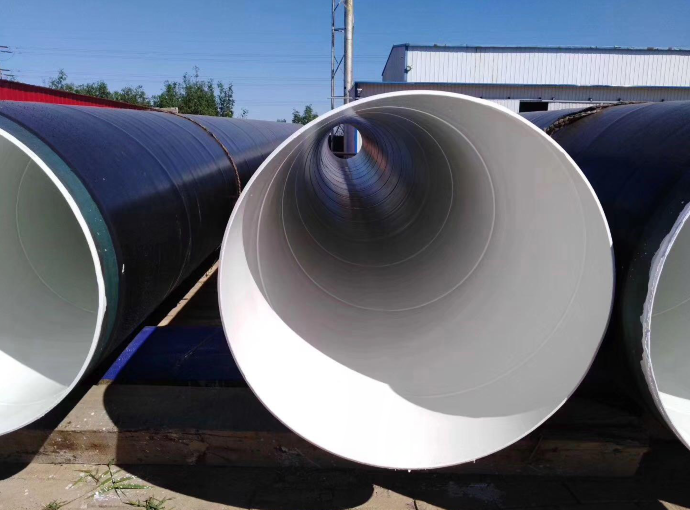
3PE anti-corrosion coating is composed of three layers:
| Layer | Material | Thickness | Function |
|---|---|---|---|
| First layer | Fusion Bonded Epoxy (FBE) | ≥100 μm | Anti-corrosion, adhesion, cathodic disbondment resistance |
| Second layer | Adhesive (AD) | 170–250 μm | Bonding FBE to PE |
| Third layer | High-density Polyethylene (HDPE) | 2.5–3.7 mm | Mechanical protection, impact resistance, soil stress resistance |
In actual operation, the three materials are mixed and integrated, and after processing, they are firmly combined with the steel pipe to form an excellent anti-corrosion layer. The processing methods are generally divided into two types: winding type and round mold wrapping type.
The PE layer is the outermost layer of 3PE coating. It is typically made of high-density polyethylene (HDPE), which provides the primary mechanical protection for the pipeline.
Why the PE layer matters:
It resists impact and abrasion during handling and backfilling.
It acts as a water vapor barrier — HDPE absorbs less than 0.01% water.
It protects the FBE layer from soil chemicals and cathodic disbondment.
PE layer thickness:
● Normal grade: 2.5–3.7 mm
● Reinforced grade: up to 4.2 mm
For rocky terrain or harsh installation conditions, a reinforced PE layer is recommended.
The 3PE coating combines the advantages of the European 2PE coating and the North American FBE coating. The bottom layer is FBE, the middle layer is a copolymer adhesive with branched functional groups, and the surface layer is high-density polyethylene. This combination has been recognized and used worldwide for over ten years.
Key advantages include:
● Excellent corrosion resistance
● Superior mechanical protection
● Low water vapor permeability
● Long service life (up to 50 years)
● Good resistance to cathodic disbondment
3PE, 2PE, and FBE are the main coating options for buried pipelines. The table below compares their main differences.
| Type | Structure | Advantages | Typical Applications |
|---|---|---|---|
| 3PE | FBE + Adhesive + HDPE | Excellent corrosion resistance, superior mechanical protection, long service life | High-pressure oil & gas trunk lines, offshore pipelines |
| 2PE | Adhesive + HDPE | Good mechanical protection, lower cost than 3PE | Low-corrosivity soil, water pipelines |
| FBE | Single-layer epoxy powder | Excellent adhesion, high-temperature resistance, no cathodic shielding | High-temperature pipelines, marine environments |
The correct 3PE production process includes:
1. Incoming steel pipe inspection – check for corrosion and remove rust.
2. Shot blasting and rust removal – ensure surface cleanliness and anchor pattern depth.
3. Heating – intermediate frequency heating to required temperature.
4. Epoxy powder spraying – apply FBE layer.
5. Adhesive extrusion – side winding of adhesive.
6. PE extrusion – side winding and embedding of PE layer.
7. Water cooling.
8. Inspection and marking.
9. Stacking and shipping.
3PE-coated steel pipes are used to protect underground cables, providing mechanical strength and corrosion resistance.
3PE coating is specified under different regional and international standards. The main standards are listed below. Selection depends on the project location and the owner's specification requirements.
| Standard | Scope |
|---|---|
| ISO 21809-1 | External coatings for buried/submarine pipelines – 3LPE/3LPP |
| DIN 30670 | Polyethylene coatings for buried steel pipes |
| GB/T 23257 | Polyethylene anti-corrosion coating for buried steel pipelines (China) |
| CSA Z245.21 | External polyethylene coating for steel pipe (Canada) |
Q1: What is the difference between 3PE and FBE?
A: FBE is a single-layer epoxy coating; 3PE adds an adhesive and PE layer, offering better mechanical protection.
Q2: What is the standard thickness of 3PE coating?
A: FBE ≥100μm, adhesive 170–250μm, PE 2.5–3.7mm (normal grade), up to 4.2mm for reinforced grade.
Q3: Can 3PE coated pipe be welded?
A: Yes. The pipe ends are left bare (100–150mm) for welding, then field joint coating is applied.
Related Resources
● Pipe Coating Anti-corrosion Treatment Process
● FBE Coated Steel Pipe: Advantages & Applications
● SSAW Steel Pipe Manufacturing Process
● Galvanizing of Carbon Steel Pipe: Selection Guide for Zinc Coating Thickness
Related information
Copyright @2017 Hunan Standard Steel Co.,Ltd and Husteel Industry Group All Rights Reserved