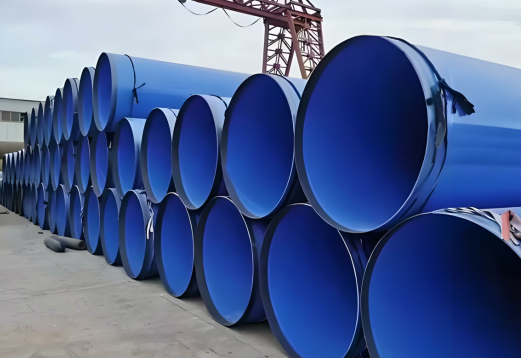
FBE Coated Anti-corrosion Steel Pipe is nearly 30 years to develop a new type of
pipe coating, the use of electrostatic spraying process coated fusion bonded epoxy powder coating to form a thin film. The pipe coating has the advantages of simple coating operation, no pollution, good impact resistance and bending resistance, and high temperature and high resistance. It has been widely used in foreign countries.
Production Process:
FBE coating is a thermosetting material made from solid epoxy resin, curing agent, and various additives through mixing, crushing, and processing. During coating, the steel pipe is heated to 220-230℃, and then the hot-melt coating is sprayed onto the pipe surface using an electrostatic adsorption coating method, followed by cooling and curing.
Coating Thickness:
Single-layer FBE coating thickness is 300-500μm;
Double-layer FBE (base layer FBE + top layer reinforced FBE) coating thickness is generally controlled at 450-800μm.
Double-layer FBE System (2FBE Coating):
Base Layer: Standard FBE, primarily providing corrosion protection and adhesion.
Top Layer: Toughened FBE, with elastomers or thermoplastic modifiers added to improve impact and bending resistance, suitable for harsh terrains (such as rocky areas and permafrost regions), primarily providing mechanical protection. The combination of both significantly improves overall performance (especially impact resistance), making it one of the current mainstream high-performance choices.
Importance of Pretreatment:
To ensure coating effectiveness, the steel pipe surface must undergo pretreatment (such as sandblasting) before coating. It must achieve Sa 2.5 grade (near-white metal grade) and the specified anchor pattern depth (typically 50-90μm); this is crucial for ensuring coating adhesion.
Advantages and Disadvantages of FBE Coating:
Core Advantages:
● Excellent adhesion.
● Excellent resistance to chemical corrosion and cathodic disbondment.
● Good insulation, resistance to soil stress, and high temperature resistance (up to 100℃ or higher).
● Minimal current required for cathodic protection, excellent compatibility with cathodic protection systems.
● Uniform coating, leak-free, and environmentally friendly.
Main Limitations:
● Compared to composite coatings such as 3PE, its resistance to mechanical impact (especially sharp impacts) is weaker.
● Compared to
3PE coatings, its water absorption rate is slightly higher.
● In extremely harsh environments with a risk of mechanical damage or under high temperature and pressure conditions, reinforced FBE or composite coatings may need to be selected.
Coating Standards and Specifications:
API RP 5L2 (American Petroleum Institute)
ISO 21809-2 (International Organization for Standardization)
CAN/CSA-Z245.20 (Canadian Standards Association)
GB/T 18593 "Anti-corrosion Coating with Fusion-Bonded Epoxy Powder Coatings"
SY/T 0315 "Technical Standard for Fusion-Bonded Epoxy Powder Coatings for Steel Pipelines"
FBE Anti-corrosion Tube Products Used in:
Coal mine: suitable for coal mine drainage, downhole spray, positive and negative pressure ventilation, gas drainage, fire sprinkler and other pipe network.
Power plant: thermal power plant process water waste, water supply pipeline.
Fire: For the anti-spray, sprinkler system of water supply pipe with excellent applicability.
Expressway: electric power, communication, highway and other cable protection casing.
Municipal engineering: for high-rise building water supply, heating network heating, water works, gas transmission, buried water and other pipelines.
Sewage treatment: sewage treatment discharge pipes, sewage pipes and biological pool anti-corrosion works.
Agriculture: agricultural irrigation pipe, deep well pipe, drainage pipe and other networks.
Application Cases:
a. Oil and Gas Pipelines: This is the largest and earliest application area for FBE, especially for oil, gas, and refined oil pipelines, as well as high-temperature gathering and transportation pipelines.
b. Pipe Fittings and Elbows Corrosion Protection: FBE's uniform coating capability makes it particularly suitable for corrosion protection of irregularly shaped
pipe fittings (tees,
elbows, valves), which is a challenge for spiral wound coatings.
c. Underwater Pipelines: Due to its good adhesion and water resistance, it is also commonly used for sections crossing rivers and lakes.
d. Recoating and Repair: When repairing in-service pipelines, FBE can also be used as one of the main coating technologies for on-site patching or repairing old pipelines.
On-site Repair Methods:
Weak points in the pipe coating can be treated with solvent-free epoxy liquid coatings, heat-shrinkable sleeves/tapes, or radiation-crosslinked polyethylene heat-shrinkable sleeves, which have high compatibility with the base FBE coating.
Development trends:
Low-temperature curing FBE: Developed to save energy and suitable for heat-sensitive pipe materials (such as thin-walled pipes and high-strength steel).
Ultra-high/low temperature applicable FBE: Adaptable to extreme climates such as the Arctic's frigid temperatures or desert high temperatures.
Read more: Types of Coated Carbon Steel Pipes
 sales@hu-steel.com
 English
 Español