sales@hu-steel.com
 English
 Español

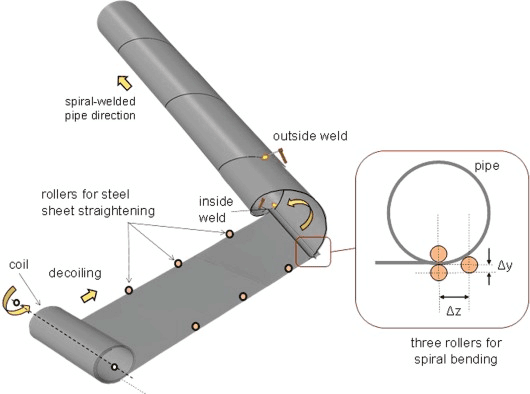
SSAW Steel Pipe (Spiral Submerged Arc Welded Pipe) uses steel strip as raw material. The strip is continuously fed into a forming unit at a certain angle, and gradually rolled into a spiral cylinder shape by rollers. Simultaneously, submerged arc welding is performed on both the inner and outer sides to form a continuous weld seam.
● The weld seam is at a certain angle to the pipe axis, avoiding principal stress and resulting in better stress distribution;
● Suitable for large-diameter (219mm~3600mm) and medium-wall-thickness (3.2mm~25.4mm) pipelines.
Forming Angle: The strip is fed at a specific forming angle (typically 15°–50°). This angle determines the pipe diameter that can be produced from a given strip width — the smaller the angle, the larger the diameter.
● The weld seam length is 30%~100% longer than that of straight seam welded pipe, theoretically resulting in a higher probability of defects;
● The geometric dimensional accuracy is slightly inferior to that of straight seam welded pipe;
● It is generally only suitable for Class 3 and Class 4 areas (oil and gas long-distance pipeline design specifications).
(1) Raw Material Inspection
The raw materials are strip coil, welding wire and flux. They must undergo rigorous physical and chemical testing before being put into use.
(2) Strip Butt Welding
The strip head and tail are joined by single-wire or double-wire submerged arc welding. Automatic submerged arc welding is used for repair welding after rolling into a steel pipe.
(3) Leveling, Milling & Pre-Bending
Before forming, the strip undergoes leveling, edge milling, trimming, planing, surface cleaning, and pre-bending of the edge.
(4) Strip Conveying Control
Electric contact pressure gauges are used to control the pressure of the cylinders on both sides of the conveyor, ensuring smooth strip delivery.
(5) Spiral Forming
External or internal control roll forming is adopted to gradually shape the strip into a spiral tube blank.
(6) Weld Gap Control
The weld gap control device ensures that the weld gap meets welding requirements. Pipe diameter, misalignment, and weld gap are strictly controlled.
(7) Inner & Outer Submerged Arc Welding
Both inner and outer welds are performed using single-wire or double-wire submerged arc welding to obtain stable welding specifications. Typical welding speed: 1.5–3 m/min; current fluctuation ≤5%.
(8) Online Ultrasonic Testing
The weld seams are inspected by an online continuous ultrasonic flaw detector, ensuring 100% non-destructive testing coverage of the spiral welds. If a defect is detected, it automatically alarms and sprays a mark, allowing production workers to adjust process parameters and eliminate the defect in time.
(9) Plasma Cutting
An air plasma cutting machine is used to cut the continuous pipe into single lengths.
(10) First Inspection System
After cutting into single pipes, each batch undergoes a strict first inspection to check weld mechanical properties, chemical composition, fusion status, surface quality, and NDT results. Only qualified pipes are officially put into production.
(11) Defect Re-Examination
Areas with continuous ultrasonic flaw marks are re-examined by manual ultrasonic and X-ray inspection. If defects are confirmed, they are repaired and re-inspected until eliminated.
(12) T-Joint X-ray Inspection
The strip butt weld and the T-joint intersecting with the spiral weld are inspected by X-ray television or filming.
(13) Hydrostatic Pressure Test
Each pipe undergoes a hydrostatic pressure test with radial sealing. Test pressure up to 20MPa; holding time ≥10 seconds. Test parameters are automatically printed and recorded.
(14) Pipe End Machining
Pipe ends are machined so that end face verticality, bevel angle, and blunt edge are accurately controlled.
| Stage | Equipment |
|---|---|
| Raw Material Preparation | Uncoiler, leveling machine, milling machine, strip butt welder |
| Forming & Welding | Spiral forming machine, inner/outer SAW welding heads, flux recovery system |
| Inspection & Testing | Online ultrasonic tester, X-ray imaging system, hydrostatic tester |
| Finishing & Delivery | Plasma cutting machine, pipe end facer, weighing & marking system |
Read more:
● 3PE Coating Anti-corrosion Steel Pipe Material
● LSAW Steel Pipe Manufacturing Process
● ERW vs. LSAW vs. SSAW: Which One to Choose?
Related information
Copyright @2017 Hunan Standard Steel Co.,Ltd and Husteel Industry Group All Rights Reserved