sales@hu-steel.com
 English
 Español
Seamless steel pipes (SMLS) are widely used in petroleum, chemical, natural gas, power, and machinery manufacturing industries. Their quality and safety directly affect the reliable operation of engineering projects. To ensure traceability of steel pipes from factory to use, manufacturers must spray or engrave marking information on the pipe surface.
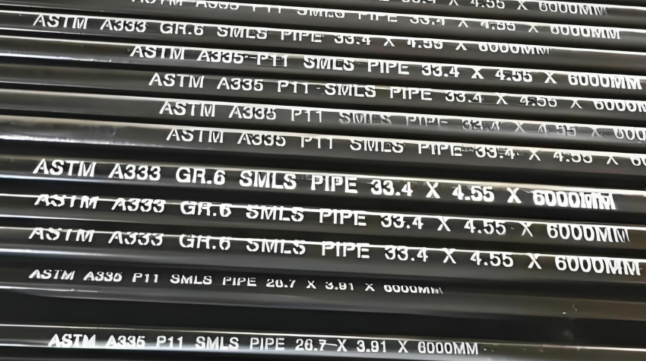
● Quality grade or pressure rating
1. Inkjet Printing
Inkjet printers are currently the most widely used marking equipment for steel pipes. They can spray various texts, patterns, barcodes, and other markings onto the surface of steel pipes. They form the markings by spraying ink onto the steel pipe surface in a non-contact manner.
2. Laser Marking Machine
Laser marking machines use a high-energy laser beam to etch permanent markings onto the surface of steel pipes.
Technical Principle:
The laser's thermal effect oxidizes or vaporizes the surface material of the steel pipe, creating clear, wear-resistant characters or graphics.
Advantages:
Permanent and clear markings, wear-resistant and corrosion-resistant, suitable for harsh working conditions;
Can engrave small fonts, special symbols, barcodes, QR codes, and other complex content;
No consumables (ink), environmentally friendly.
Limitations:
Higher equipment investment cost; Requires professional technicians for operation and maintenance;
Marking speed is slightly slower than inkjet printers.
3. Printing Machine Marking
Printing machines use mechanical contact to roll or press marking information onto the surface of steel pipes, a traditional marking method.
Advantages:
Low equipment cost and simple structure; easy operation and simple maintenance; clear and legible markings.
Limitations:
Cannot print diverse content such as colors and patterns;
Mechanical contact may cause slight indentations on the pipe surface;
Changing marking content requires adjusting the type wheel, resulting in poor flexibility.
Conclusion:
Marking seamless steel pipes is not only a marking process but also a core link in product quality traceability and safety management. Inkjet printers, laser marking machines, and printing machines each have their advantages and disadvantages; companies should make a comprehensive selection based on product positioning, customer requirements, production scale, and budget. Regardless of the method used, ensuring that the markings are clear, durable, and traceable is the fundamental purpose of spray marking.
Read more: Seamless Steel Pipe Sizes and Weights or MS and GI Pipe Difference
Related information
Copyright @2017 Hunan Standard Steel Co.,Ltd and Husteel Industry Group All Rights Reserved