sales@hu-steel.com
 English
 Español
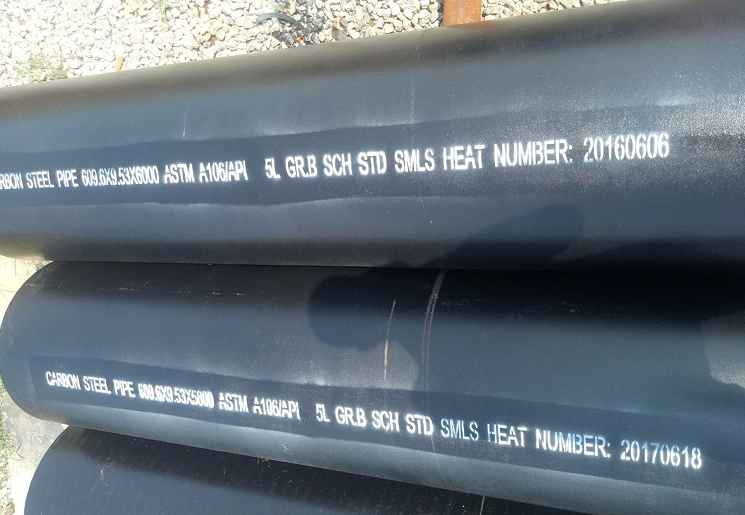
ASTM A106 is the Standard Specification for Seamless Carbon Steel Pipe for High-Temperature Service. The current version is ASTM A106/A106M-19, equivalent to ASME SA106.
The specification covers seamless carbon steel pipe for high-temperature service, suitable for welding, bending, flanging, and similar forming operations. It includes three grades: Grade A, Grade B, and Grade C. ASTM A106 Grade B is the most commonly used steel grade, widely applied in oil refineries, natural gas processing plants, power plants, petrochemical facilities, boilers, and shipbuilding. These pipes are used to transport fluids and gases at high temperatures and pressures.
Looking for grade selection or supply?
▶ See our [ASTM A106 Pipe Selection Guide] for Grade A, B, and C comparison and available sizes.
ASTM A106 Grade C seamless pipes (also known as ASME SA106 Grade C pipes) are carbon-manganese steel pipes for high-temperature large-diameter boilers and superheaters. With higher carbon and manganese content than Grade B, Grade C offers higher strength (yield ≥275 MPa) and is used in supercritical power plants, deep-sea oil and gas extraction, and nuclear power auxiliary pipelines. Compared with 20G boiler steel, Grade C offers approximately 12% higher yield strength and can replace 20G headers with about 10% reduction in wall thickness.
| Steel Grade | C (max) | Mn | P (max) | S (max) | Si (min) | Cr (max) | Cu (max) | Mo (max) | Ni (max) | V (max) |
|---|---|---|---|---|---|---|---|---|---|---|
| A | 0.25 | 0.27–0.93 | 0.035 | 0.035 | 0.10 | 0.40 | 0.40 | 0.15 | 0.40 | 0.08 |
| B | 0.30 | 0.29–1.06 | 0.035 | 0.035 | 0.10 | 0.40 | 0.40 | 0.15 | 0.40 | 0.08 |
| C | 0.35 | 0.29–1.06 | 0.035 | 0.035 | 0.10 | 0.40 | 0.40 | 0.15 | 0.40 | 0.08 |
Note:
① For every 0.01% reduction in carbon content below the specified maximum carbon content, A106 seamless steel pipes are allowed to increase the manganese content by 0.06% above the specified maximum manganese content, but the maximum shall not exceed 1.35%;
②The sum of the five elements Cu, Ni, Cr, Mo, and V shall not exceed 1.00%
| Steel Grade | Tensile Strength (min) | Yield Strength (min) | Elongation (min) | Delivery Condition |
|---|---|---|---|---|
| A | ≥330 MPa | ≥205 MPa | ≥30% | Annealed |
| B | ≥415 MPa | ≥240 MPa | ≥30% | Annealed |
| C | ≥485 MPa | ≥275 MPa | ≥30% | Annealed |
△ Hot-rolled process: billet preparation → heating → piercing → rolling → reheating → sizing → heat treatment → straightening → finishing → inspection
△ Cold-drawn process: blank preparation → pickling and lubrication → cold rolling (drawing) → heat treatment → straightening → finishing → inspection
Steelmaking:
The steel shall be killed steel, produced by open-hearth, basic-oxygen, or electric-furnace process, possibly combined with separate degassing or refining. If secondary melting (electroslag remelting or vacuum-arc remelting) is employed, the heat shall be defined as all ingots remelted from a single primary heat.
Hot-finished pipe: Need not be heat treated. When heat treated, it shall be at 650°C (1200°F) or higher.
Cold-drawn pipe: Shall be heat treated after the final cold draw pass at 650°C (1200°F) or higher.
This requirement ensures stress relief and consistent mechanical properties.
For pipe NPS2 (DN50) and under, the pipe shall stand being bent cold through 90° around a cylindrical mandrel with a diameter of 12 times the outside diameter, without developing cracks.
For close coiling, the pipe shall stand being bent cold through 180° around a cylindrical mandrel with a diameter of 8 times the outside diameter, without failure.
Each length of pipe shall be subjected to the hydrostatic test without leakage through the pipe wall.
As an alternative to the hydrostatic test—at the manufacturer's option or where specified in the purchase order—the full body of each pipe may be tested with a non-destructive electric test (NDE, a form of NDT).
ASTM A106 requires the following tests on each length or lot:
| Test | Purpose |
|---|---|
| Tensile test | Verify tensile strength, yield strength, and elongation |
| Bending / flattening test | Verify ductility and formability |
| Hydrostatic test | Verify pressure tightness |
| Non-destructive electric test (UT/ET) | Detect internal and surface defects |
| Chemical composition verification | Confirm element content per heat |
Third-party inspection (SGS, BV, Intertek) can be arranged at the buyer's request.
Both markings must appear on the mill test certificate, along with the product specification number and material grade.
The mill test certificate documents chemical composition, mechanical properties, and test results. It is available as EN 10204 3.1 or 3.2 as required.
Read more:
● ASTM A53 Gr.B ERW Steel Pipe
● ASTM A53 Seamless Carbon Steel Pipe
Related information
Copyright @2017 Hunan Standard Steel Co.,Ltd and Husteel Industry Group All Rights Reserved