sales@hu-steel.com
 English
 Español
ASTM A53 Type S is the seamless version of the ASTM A53 standard — produced by hot working, and possibly cold finishing, with no weld seam. It is one of the most widely used carbon steel pipes for steam, water, air, and structural applications.
This guide focuses on Type S (seamless) steel pipe, covering its definition, manufacturing process, grades and specifications, and areas of application. Finally, a brief comparison with ASTM A106 is included at the end for reference during selection.
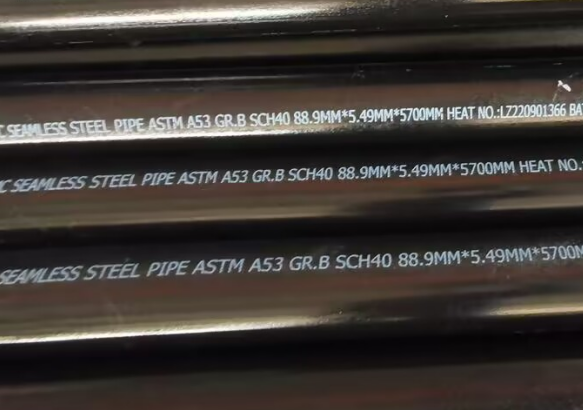
ASTM A53 (also known as ASME SA53) is the standard specification for pipe, steel, black and hot-dipped, zinc-coated, welded and seamless.
The standard covers three types (F, E, S) and two grades (A, B):
● Type F—Furnace-butt-welded, continuous welded, Grade A only.
● Type E—Electric-resistance-welded, Grades A and B.
● Type S—Seamless pipe, Grades A and B.
Type S is the seamless pipe option under this specification. Because there is no weld seam, it offers uniform strength around the entire circumference and is suitable for higher-pressure and higher-temperature service than Type F or Type E.
ASTM A53 Type S is sized according to the nominal pipe size (NPS) system. It is commonly available with national pipe thread ends or with plain cut ends.
| Feature | Type F | Type E | Type S |
|---|---|---|---|
| Manufacturing | Furnace-butt-welded | Electric-resistance-welded | Seamless |
| Grades | Grade A only | Grades A and B | Grades A and B |
| Weld Seam | Yes | Yes | None |
| Size Range | NPS 1/8 – NPS 4 | NPS 1/8 – NPS 26 | NPS 1/8 – NPS 26 |
| Typical Applications | Low-pressure | General purpose | High-pressure, high-temperature |
Type S is the preferred choice when the application requires higher pressure capacity, better fatigue resistance, or when a weld seam is not permitted by the design code.
ASTM A53 Seamless pipe is available in two grades: Grade A and Grade B.
| Property | Grade A | Grade B |
|---|---|---|
| Tensile Strength (min) | 330 MPa | 415 MPa |
| Yield Strength (min) | 205 MPa | 240 MPa |
| Carbon (max) | 0.25% | 0.30% |
| Manganese (max) | 0.95% | 1.20% |
| Typical Applications | Low-pressure, structural | High-pressure, general purpose |
Key points:
Grade B is the most commonly ordered grade under ASTM A53. It offers higher strength and is often dual-certified to ASTM A106 Grade B, meaning the same pipe meets the requirements of both standards.
A53 GR.A has relatively low chemical composition requirements and is suitable for low-pressure applications under general working conditions. A53 GR.B has higher material requirements and can be used in pipeline systems under high temperature and high pressure.
ASTM A53 Seamless steel pipe covers NPS 1/8 to NPS 26. The pipe is sized according to the nominal pipe size system, with wall thicknesses available in standard schedules (SCH 10, SCH 40, SCH 80, etc.) or custom thicknesses.
| NPS | Common OD (mm) | Common Wall Thickness (SCH 40) |
|---|---|---|
| 1/2" | 21.3 | 2.77 mm |
| 1" | 33.4 | 3.38 mm |
| 2" | 60.3 | 3.91 mm |
| 4" | 114.3 | 6.02 mm |
| 6" | 168.3 | 7.11 mm |
| 8" | 219.1 | 8.18 mm |
Wall thickness varies by schedule. Custom sizes available upon request. ▶ For the full range of sizes, refer to our [Seamless Steel Pipe Size Chart].
ASTM A53 Type S seamless pipe is suitable for:
1. Steam, water, and air conveyance — the most common applications
2. Petroleum, natural gas, and chemical industries — for transporting liquids and gases
3. Structural applications — where weldability and strength are required
4. High-temperature and high-pressure pipeline systems — Grade B is preferred for these conditions
ASTM A53 Grade B Seamless is our most popular product under this specification, and A53 pipe is commonly dual-certified to A106 Grade B seamless pipe.
Note: For structural applications, ASTM A500 tube is sometimes preferred over A53 Type S. Both are available in the same NPS sizes, but A500 is specifically designed for structural use with tighter mechanical property requirements. For fluid conveyance, A53 Type S remains the standard choice.
A53 Seamless steel pipe manufacturing is divided into hot-rolled and cold-drawn processes.
1. Hot-rolled seamless steel pipe:
Tube billet → Heating → Piercing → Three-roller/cross-rolling & continuous rolling → De-piping → Sizing → Cooling → Straightening → Hydraulic test → Marking → Inspection
2. Cold-drawn seamless steel tube:
Tube blank → Heating → Piercing → Heading → Annealing → Pickling → Oiling → Multiple cold drawing → Blank tube → Heat treatment → Straightening → Hydraulic test → Marking → Storage
Type S pipes are typically delivered in the hot-rolled or heat-treated condition, depending on the grade and the requirements of the order.
ASTM A53 specification covers seamless and welded black and hot-dipped galvanized pipe in NPS 1/8 to NPS 26. The steel must be open-hearth, basic-oxygen, or electric-furnace processed and must meet the following chemical requirements: carbon, manganese, phosphorus, sulfur, copper, nickel, chromium, molybdenum, and vanadium.
Mechanical testing requirements include:
● Tension test — verifies tensile strength and yield strength
● Bend test — verifies ductility
● Flattening test — verifies soundness of the pipe body
● Hydrostatic test — verifies pressure-bearing capacity and sealing, with no leakage through the pipe body
● Non-destructive electric test — ensures the full volume of the pipe meets the standard
The purchaser has the right to perform any of the inspections and tests set forth in this specification where deemed necessary to ensure that the pipe conforms to the specified requirements.
| Feature | ASTM A53 Type S | ASTM A106 |
|---|---|---|
| Seamless | ✅ Yes | ✅ Yes |
| Welded (ERW) | ❌ No (Type E is welded) | ❌ No |
| Service Temperature | Moderate | High-Temperature (up to 750°F / 400°C) |
| Silicon Content | No requirement | ≥0.10% silicon |
| Typical Applications | Steam, water, air, structural | High-temperature process piping, boilers |
| Dual Certification | Often dual-certified to A106 Gr.B | — |
Selection Guide:
For steam, water, air, and general structural applications → ASTM A53 Type S is usually sufficient and more economical.
For high-temperature process piping (above 400°C) or boiler applications → ASTM A106 Grade B is the appropriate choice.
For moderate operating conditions where either is suitable → Opt for dual-certified products that meet both A53 Grade B and A106 Grade B standards to leverage the advantages of both; compliance with dual standards simplifies procurement and inventory management.
Q1: What is ASTM A53 Type S?
A: Type S is the seamless pipe under the ASTM A53 standard. It is produced by hot working (and possibly cold finishing) with no weld seam. It is available in Grade A and Grade B, and covers NPS 1/8 to NPS 26.
Q2: Can ASTM A53 Type S be used for high-temperature applications?
A: ASTM A53 is generally suitable for moderate-temperature service. For high-temperature process piping (above 400°C), ASTM A106 Grade B is the recommended choice.
Q3: What is the difference between A53 Gr.B and A106 Gr.B?
A: Both have the same strength (415 MPa tensile, 240 MPa yield). A106 has stricter limits on phosphorus and sulfur, and requires a minimum silicon content for better high-temperature performance. A53 Gr.B is for general mechanical and pressure use; A106 Gr.B is for high-temperature service up to 427°C.
Q4: Can A53 Gr.B replace A106 Gr.B?
A: Not for high-temperature service. A106 has stricter chemistry requirements. However, many mills dual-certify A53 Gr.B to A106 Gr.B — the same pipe meets both standards. Check the MTC for dual certification. Always confirm with the engineer before substituting.
Q5: Does A53 Type S pipe need coating?
A: It depends on the environment. A53 pipe can be supplied black (uncoated) or hot-dipped galvanized. For outdoor, humid, or corrosive conditions, galvanized or painted pipe is recommended. For indoor or dry service, black pipe is usually sufficient.
Q6: What should buyers check before ordering A53 Type S pipe?
A: Confirm the grade (A or B), dimensions (NPS and schedule), end finish (plain or threaded), coating requirement (black or galvanized), and documentation (MTC, hydrostatic test report). If dual certification to A106 is needed, specify it in the order.
Read more:
● ASTM A106 GR.B Seamless Pipe
● Seamless Steel Pipe Sizes and Weights
Related information
Copyright @2017 Hunan Standard Steel Co.,Ltd and Husteel Industry Group All Rights Reserved