sales@hu-steel.com
 English
 Español

This article provides technical data for shipbuilding seamless steel pipes, including chemical composition, mechanical properties, dimensional tolerances, and classification society requirements. ▶ For product availability and ordering, view our [Seamless Carbon Steel Pipe for Ships].
Shipbuilding seamless steel pipes are mainly used for Class I and Class II pressure piping, boiler tubes, and superheater units. They must meet strict requirements for chemical composition, mechanical properties, and dimensional accuracy.
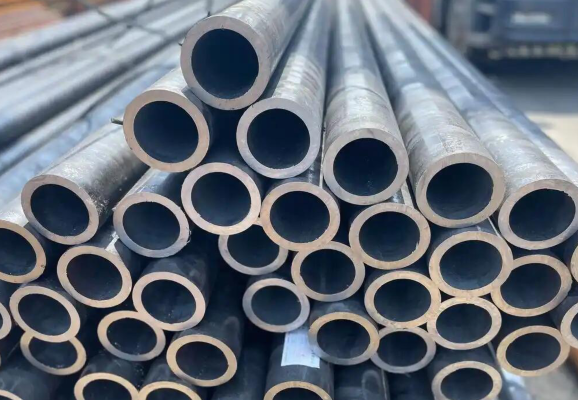
Shipbuilding seamless steel pipes are available in multiple international standard systems. The table below compares key standards, typical applications, and classification society notes.
Standards & Application Comparison
| Standard | Common Grades | Typical Application | Classification Society Notes |
| GB/T 5312 | 320–490 | Marine boilers, Class I/II piping | CCS specific |
| ASTM A106 | A/B/C | High-temperature service | Additional surveys required |
| EN 10216 | P195–P265 | Pressure purposes | Accepted by DNV, LR, ABS |
| JIS G3455 | STS 370–480 | High-pressure service | NK specific |
The technical data in the following sections is based on GB/T 5312. For other standards such as ASTM A106 or EN 10216, the chemical composition and mechanical properties may vary. Please refer to the respective standards for detailed requirements.
The table below lists the chemical composition limits for shipbuilding seamless steel pipe grades 320–490. S and P are controlled at ≤0.035% and ≤0.030% for higher grades.The table below lists the chemical composition limits for shipbuilding seamless steel pipe grades 320–490 based on GB/T 5312, with ASTM A106 Grade B and EN 10216-2 P265GH listed for comparison.
| Grade | C | Si | Mn | P | S |
| GB/T 5312 – 320 | ≤0.16 | ≤0.35 | 0.40–0.70 | ≤0.035 | ≤0.035 |
| GB/T 5312 – 360 | ≤0.17 | ≤0.35 | 0.40–0.80 | ≤0.035 | ≤0.035 |
| GB/T 5312 – 410 | ≤0.21 | ≤0.35 | 0.40–1.20 | ≤0.035 | ≤0.035 |
| GB/T 5312 – 460 | ≤0.22 | ≤0.35 | 0.80–1.40 | ≤0.035 | ≤0.030 |
| GB/T 5312 – 490 | ≤0.23 | ≤0.35 | 0.80–1.50 | ≤0.035 | ≤0.030 |
| ASTM A106 Gr.B | ≤0.30 | ≥0.10 | 0.29–1.06 | ≤0.035 | ≤0.035 |
| EN 10216-2 P265GH | ≤0.20 | ≤0.40 | 0.80–1.40 | ≤0.025 | ≤0.015 |
| Grade | Tensile Strength (MPa) | Yield Strength (MPa) | Elongation (%) |
| GB/T 5312 – 320 | 320–410 | ≥195 | ≥25 |
| GB/T 5312 – 360 | 360–480 | ≥215 | ≥24 |
| GB/T 5312 – 410 | 410–530 | ≥235 | ≥22 |
| GB/T 5312 – 460 | 460–580 | ≥265 | ≥21 |
| GB/T 5312 – 490 | 490–610 | ≥275 | ≥21 |
| ASTM A106 Gr.B | ≥415 | ≥240 | ≥30 |
| EN 10216-2 P265GH | 410–530 (≤16 mm) | ≥265 (≤16 mm) | ≥22 |
Shipbuilding seamless steel pipes are available in outer diameters from 8 mm to 1240 mm and wall thicknesses from 1 mm to 200 mm (special specifications available upon request).
|
Types of steel tubes |
Out diameter | Wall thickness | ||
|
Cold-rolled tubes |
Tube sizes (mm) |
Tolerances (mm) |
Tube sizes (mm) |
Tolerances (mm) |
|
>30-50 |
±0.3 |
≤30 |
±10% | |
|
>50-219 |
±0.8% |
|||
|
Hot-rolled tubes |
>219 |
±1.0% |
>20 |
±10% |
Shipbuilding pipes must be certified by the classification society. Manufacturers must submit their products and production processes to the classification society for review. Only after obtaining factory approval and product type approval certificates can their products be used in shipbuilding. Steel pipes are marked with the classification society's inspection mark upon leaving the factory.
China Classification Society Material and Welding Specifications - China Classification Society (CCS)
Det Norske Veritas (DNV) Specifications - Det Norske Veritas (DNV)
Lloyd's Register (LR) Specifications - Lloyd's Register (LR)
Germanischer Lloyd (GL) Specifications - Now part of DNV
American Bureau of Shipping (ABS) Specifications - American Bureau of Shipping (ABS)
Bureau Veritas (BV) Specifications - Bureau Veritas (BV)
RINA Specifications - RINA
NK Classification Society (NK) Specifications - Nippon Kaiji Kyokai (NK)
GB/T 5312 - Chinese National Standard
CCS Grade A/B/D/E: China Classification Society material. A/B represents general strength, D/E represents high strength, and Grade E has excellent low-temperature impact toughness.
ABS Grade A/B/D/E: American Bureau of Shipping material. The grading method is similar to CCS, but the requirements are slightly different.
Uses I, II, III: ASTM A106 is sometimes used, but it must meet the additional inspection requirements of the ship regulations. "Uses I, II, III" refers to the classes of ship piping systems (Class I, II, and III).
Ship piping systems are classified into three levels according to IACS Unified Requirements:
Class I: High-pressure, high-temperature, or corrosive media (e.g., fuel injection, high-pressure hydraulic)
Class II: Medium-risk systems (e.g., cooling, heating, auxiliary systems)
Class III: Low-pressure open systems (e.g., drainage, overflow, vent, exhaust)
ASTM A106 Clarification: ASTM A106 is not a shipbuilding standard. When used in shipbuilding, it must undergo additional inspections as required by the relevant classification society and comply with the society's specific rules for piping materials.
Shipbuilding seamless steel pipes undergo the following tests:
1. Chemical Composition Analysis – ensures material meets standard requirements.
2. Non-Destructive Testing (NDT) – 100% eddy current testing (ET) is basic; 100% ultrasonic testing (UT) is mandatory for critical systems.
3. Hydrostatic Test – verifies pressure-bearing capacity and sealing integrity.
4. Mechanical Properties Test – impact toughness test is mandatory.
5. Dimensional Accuracy Test – tighter tolerances for compact engine rooms.
Q1: What is the yield strength of GB/T 5312 grade 490?
A: Per CCS rules, grade 490 has a minimum yield strength of ≥275 MPa.
Q2: What are Class I, II, and III piping systems?
A: Class I covers high-pressure/high-temperature/corrosive systems; Class II covers medium-risk systems; Class III covers low-pressure open systems.
Q3: How does ASTM A106 Gr.B compare to GB/T 5312 grades?
A: ASTM A106 Gr.B has a minimum yield strength of 240 MPa and minimum tensile strength of 415 MPa, with higher elongation (≥30%) than most GB/T 5312 grades. Its chemistry allows higher carbon (≤0.30%) and requires minimum silicon (≥0.10%). It is widely dual-certified with API 5L Grade B.
Q4: What is the difference between P265GH and GB/T 5312 grades?
A: EN 10216-2 P265GH has tighter P and S limits (≤0.025%/≤0.015%) than most GB/T 5312 grades, with yield strength ≥265 MPa for wall thickness ≤16 mm. It is accepted by DNV, LR, and ABS for pressure purposes.
Related Resources:
● Seamless Steel Pipe Sizes and Weights
● Shipbuilding Seamless Carbon Steel Pipe: Grades, Sizes & Approval
● Stainless Steel Ship Piping: Material & Marine Applications
Related information
Copyright @2017 Hunan Standard Steel Co.,Ltd and Husteel Industry Group All Rights Reserved