Comparative Analysis of ERW Carbon Steel Pipe and Spiral Welded Pipe (SSAW):
1. Manufacturing Process and Residual Stress
ERW Carbon Steel Pipe (Straight Seam High-Frequency Electric Resistance Welded): This type of pipe is formed by continuous roll forming of hot-rolled steel strip. Utilizing the skin effect and proximity effect of high-frequency current, the butt joint edges melt instantly and achieve solid-state hot-press welding under the action of extrusion rollers. Its welding heat input is concentrated and fast, resulting in relatively small welding deformation and residual stress. Subsequent online weld heat treatment, sizing, and straightening processes can further optimize stress distribution and microstructure. A mature ERW process ensures that the weld performance is close to that of the base material.
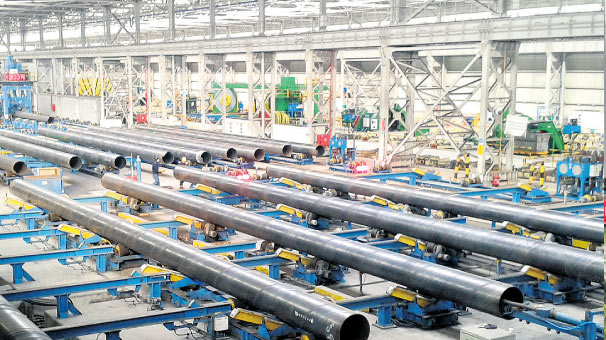
Spiral Welded Steel Pipe (SSAW): This type of pipe is made by rolling steel strip at a certain helical angle and continuously submerged arc welding. It has a longer weld seam, a larger total welding heat input, and complex superposition of forming stress and welding residual stress during the forming process. If the process control is inadequate, the residual stress may be high. Subsequent mechanical expansion (mechanical stress relief) processes can effectively reduce and homogenize residual stress, which is a key process for high-standard spiral pipes (such as those used in oil and gas pipelines). The weld seam uses welding wire and flux, belonging to fusion welding. The chemical composition of the weld seam differs reasonably from the base material, and joint performance can be guaranteed through process optimization.
2. Raw Material Selection
ERW Steel Pipe: Typically uses hot-rolled steel coils that meet standard requirements, with high requirements for the surface quality, shape, and chemical composition stability of the steel strip.
Spiral Welded Pipe: Also uses hot-rolled steel strips or plates that meet standards (such as
API 5L). In important long-distance oil and gas pipeline projects, the requirements for raw materials are as stringent as for straight seam pipes. The so-called "use of low-grade steel strips" is not an inherent aspect of the process, but rather a market behavior of individual manufacturers for cost considerations, and does not represent the current status of high-end spiral pipe products.
3. Economic Efficiency and Market Supply
Large Diameter Sector: Spiral welded pipes have significant advantages in material utilization and production cost in the production of large-diameter pipes (usually referring to nominal diameters of DN400 and above), making them a core choice for long-distance pipelines and other fields.
Small and Medium Diameter Segment: For small and medium diameter steel pipes (usually referring to nominal diameters below DN350), ERW steel pipes generally have advantages in production efficiency and overall cost, with more suppliers and convenient procurement.
Intermediate Diameter: In the intermediate range of DN350 to DN500, the two processes compete, requiring comparison based on specific technical requirements and project budget.
4. Geometric Dimensions and Weld Characteristics
Dimensional Accuracy: Modern
ERW production lines, due to their continuous cold bending forming process, typically achieve high outer diameter accuracy and excellent straightness. Under the same control level, the diameter accuracy and end face perpendicularity of spiral welded pipes are generally slightly inferior to ERW pipes, but can meet standard requirements through subsequent processes such as sizing.
Weld Appearance: ERW steel pipe welds are butt welds of the base material. After removing internal and external burrs, the weld area is relatively smooth. Spiral welded pipes use submerged arc welding, resulting in continuous weld bead height on the outer surface. According to standards, this height must be controlled within specified limits. Excessive height can indeed affect the uniformity of the anti-corrosion coating; therefore, standards have clear limitations on it, and grinding is required before coating.
Impact on Fluid Transport: Theoretically, the continuous weld reinforcement on the inner side of the spiral pipe may slightly disturb the fluid smoothness. However, for most industrial transport applications (non-extreme turbulence), this effect is usually negligible and can be further optimized through internal coating treatment. ERW steel pipes have an inherent advantage in this regard due to their smooth inner wall.
Conclusion:
ERW carbon steel pipes and spiral welded steel pipes are complementary rather than substitutive. The key to selection lies in the diameter, application, standard requirements, and overall cost. For large-diameter, high-grade long-distance pipelines, spiral welded pipes using the diameter expansion process are a mature and reliable choice proven by global engineering. For small to medium diameters and applications requiring high dimensional accuracy and inner wall smoothness, ERW steel pipes are a more economical and efficient choice.
Read more: ERW Pipe Thickness Size Chart or SAW vs ERW and EFW Welded Steel Pipe
 sales@hu-steel.com
 English
 Español