sales@hu-steel.com
 English
 Español
Unlike manual welding, submerged arc welding uses welding wire as the electrode. The welding wire can be continuously fed, avoiding the interruption of welding due to frequent electrode head changes in manual welding, thus significantly improving welding efficiency. During welding, the continuously fed welding wire ignites the arc under the coverage of the granular flux. The flux partially melts and evaporates, forming a sealed cavity, within which the arc burns stably, hence the name "submerged arc welding."
China's West-East Gas Pipeline project extensively uses high-strength pipeline steel (such as X70 and X80). Pipelines are prefabricated in 12-meter-long sections in the factory, and longitudinal seams are welded using double-sided submerged arc welding (internal welding first, then external welding), before being transported to the site for circumferential welding and assembly. Currently, submerged arc welding has evolved into twin-wire and multi-wire submerged arc welding. Multi-wire technology allows the simultaneous use of 2-5 welding wires, further improving deposition efficiency and welding speed.
Double-sided submerged arc welded straight seam steel pipes are increasingly widely used in building structures, oil and gas transportation, and pressure vessels. Compared to manual welding of large-diameter straight seam steel pipes, automatic submerged arc welding has significant advantages in efficiency, quality, and consistency.
Gas shielded welding (GMAW/TIG):
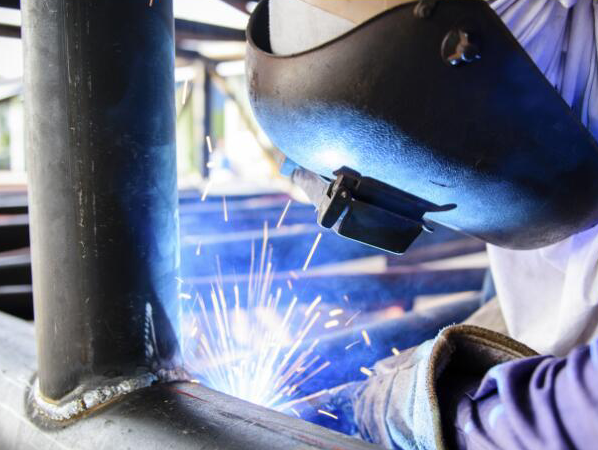
Gas shielded welding uses gas (not flux) as the protective medium. A protective gas (usually argon or an argon-rich mixture) is delivered to the arc area through the welding nozzle, displacing air and preventing weld oxidation. Its advantages include visible welding process, flexible operation, and a small heat-affected zone. It is widely used for welding stainless steel, aluminum, and thin plates. To improve welding efficiency and weld formation, 3%-5% carbon dioxide is sometimes added to the argon gas as an active gas.
Laser welding:
Laser welding is a welding method that uses a high-energy laser beam as a heat source. Its characteristics include:
● It has been widely used in the automotive, aerospace, and electronics industries, and has been successfully applied in the medical field (such as retinal repair surgery).
Related information
Copyright @2017 Hunan Standard Steel Co.,Ltd and Husteel Industry Group All Rights Reserved