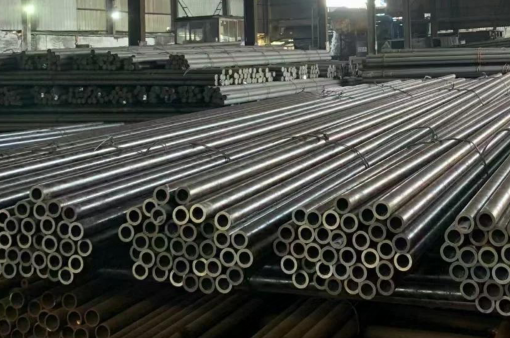
In the field of building structural support, seamless carbon steel pipes are commonly used in scenarios with high requirements for load-bearing capacity, stability, and durability due to their high strength, good compressive and torsional resistance, and structural uniformity. The choice of seamless pipes over more economical welded pipes in these cases is primarily based on the project's stringent requirements for reliability, safety, and performance consistency.
The following are the main building structural support scenarios where seamless carbon steel pipes should be prioritized or are essential:
1. Critical structures sensitive to fatigue and dynamic loads
When support components need to withstand high-frequency, high-amplitude cyclic loads or dynamic loads over long periods, the weld-free advantage of seamless steel pipes is crucial. The weld seams in welded pipes are often the origin of fatigue cracks. Seamless steel pipes eliminate longitudinal weld seams, significantly improving the fatigue life and reliability of the components.
Common application scenarios:
Roof trusses and support systems for large stadiums and convention centers: withstanding wind-induced vibrations and crowd loads.
Bridge arch ribs, hangers, and truss supports: bear fatigue loads from vehicular traffic.
High-rise building wind/earthquake resistant mega-supports and outrigger trusses: withstand alternating stresses under earthquakes or strong winds.
2. Key load-bearing components under complex high-stress states
In building structural systems, certain supporting components are located in critical positions where force flows converge and stress states are complex. Due to the uniform material and good isotropy of seamless steel pipes, stress distribution under high stress conditions is more consistent with the calculation model, avoiding abnormal increases in localized stress caused by material inhomogeneity or weld defects.
Common application scenarios:
Main compression pipes or principal chords in large-span spatial structures: such as compression members in grid shell structures and pressure ring beams in cable domes.
Support columns or braces in transfer floors of high-rise buildings: bear enormous concentrated loads and bending moments.
Work platform supports and crane rail beam supports in heavy industrial plants: bear high static and dynamic loads from heavy equipment.
3. Outdoor or harsh environment supports with special requirements for corrosive environments
In corrosive environments, the long-term durability of structural supports is extremely important. Because seamless steel pipes have smooth inner and outer surfaces, without weld seams, protrusions, or depressions, the coating/plating is more uniform and has stronger adhesion during anti-corrosion painting or galvanizing. Furthermore, the absence of weld seams prevents the accumulation of corrosive media, thus providing longer-lasting protection.
Common applications:
Outdoor structural supports in corrosive environments such as coastal areas and chemical plant areas.
Load-bearing components requiring long-term anti-corrosion treatments such as
hot-dip galvanizing.
4. Exposed structures with special aesthetic or architectural performance requirements
When structural support components are part of the architectural aesthetic expression, high requirements are placed on the purity, integrity, and processing precision of the appearance. Seamless steel pipes, with their smooth shape, lack of weld seams, and superior surface treatment, can meet high standards of architectural aesthetics.
5. Specific regulations
In certain important projects or specific structural types, design codes, owner technical specifications, or design firms may, for the highest safety level considerations, explicitly stipulate that seamless steel pipes must be used for critical load-bearing components.
Read more: Seamless Pipe vs. Welded Pipe
 sales@hu-steel.com
 English
 Español