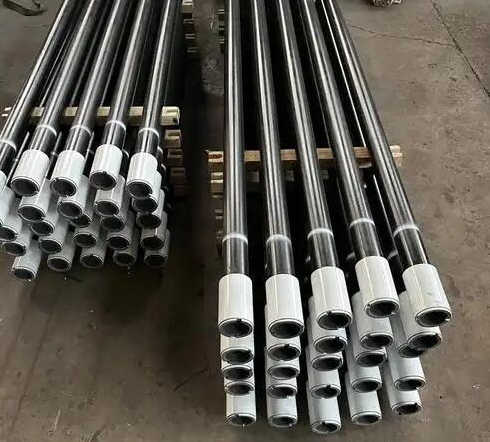
Offshore platform oil casing pipe refers to specialized casing designed, manufactured, and selected to withstand the extreme marine environment, used for constructing wellbores on offshore drilling platforms. Due to the extreme characteristics of the marine environment, such as high pressure, corrosion, and high cost, casing selection is more stringent than onshore.
Performance and Quality Requirements for Offshore Platform Oil Casing Pipe:
1. Ultra-high reliability: The daily cost of offshore platforms is extremely high; any non-productive time caused by casing failure is catastrophic.
2. System corrosion protection: It must simultaneously resist corrosion from seawater (chloride ions), formation fluids (potentially containing CO₂/H₂S), and mixtures of both.
3. Withstanding complex loads: It must withstand additional bending and fatigue loads from platform movement, waves, currents, and insulation layers.
4. Lightweight design: Reducing weight while maintaining strength to optimize platform load and cost.
Common Grades and Selection of Casing Layers for Offshore Platforms:
The casing process for an offshore well also includes guide casing, surface casing, technical casing, and production casing, but the selection logic for each layer is more conservative:
a. Conductor/Surface Casing: Addresses seabed instability, shallow flow, and installation loads.
Common Material Grades: J-55, K-55,
N-80 (high toughness)
Selection Points: Emphasizes anti-squeezing and bending performance to ensure wellhead stability. Large-diameter, thick-walled pipes are often used, ensuring excellent weldability.
b. Intermediate Casing: Isolates multiple pressure systems, abnormally high pressure, and salt deposits.
Common Material Grades: N-80, P-110, Q-125 (mainstay).
Selection Points: Highest strength requirement; a combination of strength and corrosion resistance, determining the well's long-term production life. Selected based on the highest pressure of the isolation layer; ultra-high grade steel is often required for deepwater sections.
c. Production Casing: Addresses long-term production pressure, production enhancement operations, and corrosive fluid environments. Commonly Used Material Grades:
P-110, Q-125, V-150 (High Strength);
L-80 (Sulfur Resistant), 13Cr/Super 13Cr (CO₂ Resistant), Duplex Stainless Steel (Cl⁻+CO₂ Resistant).
Selection Points: Highest integrity requirements necessitate a comprehensive evaluation of mechanical strength and long-term corrosion resistance.
Key Supporting Technologies and Special Requirements:
1. Connection Threads
High-performance special threads are mandatory. They must possess excellent gas sealing, high bending resistance, and fatigue resistance to withstand platform movement and wellbore bending. API standard threads typically do not meet the requirements.
2. Corrosion Protection:
Coating/Liner: Widely used corrosion-resistant alloy liners, internal coatings, or fiberglass liners.
Cathode Protection: Sacrificial anodes are typically used to protect the outer wall of the casing in seawater-immersed sections.
Material Upgrades: In corrosion-sensitive areas, directly using corrosion-resistant alloys is a reliable option.
3. Strict quality control
Factory acceptance testing and non-destructive testing exceeding API standards are required, and third-party on-site supervision is generally conducted.
Read more: Specifications and Dimensions of Drilling Casing
 sales@hu-steel.com
 English
 Español