sales@hu-steel.com
 English
 Español
Welded ERW square tubes and ERW rectangular tubes are steel tubes with square or rectangular cross-sections produced using the high-frequency electric resistance welding (ERW) process.
The name itself is self-explanatory:
ERW refers to the production process—high-frequency electric resistance welding.
"Square and rectangular tube" is often used as a general term, with "square tube" referring to a square cross-section and "rectangular tube" referring to a rectangular cross-section.
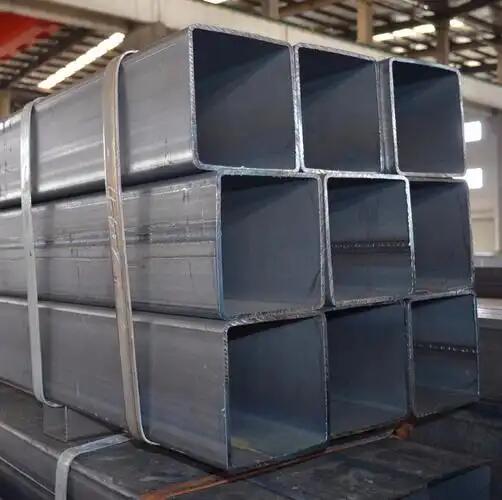
A scraper removes excess metal (burrs) extruded from the inside and outside of the weld. The ERW welded tube enters a cooling section and passes through a sizing mill to ensure precise diameter and roundness. Finally, it passes through a set of specialized dies and is gradually rolled into the desired square or rectangular cross-section. This process requires precise control to ensure the straightness of angles and edges.
ERW square tubes are manufactured from cold-rolled strip steel. Their outer diameter and wall thickness are precisely controlled with tight tolerances. Their surface is free of defects such as scratches commonly found in seamless steel pipes, resulting in a smoother and more aesthetically pleasing appearance.
As a closed tubular section, it has a significantly greater section modulus and bending and torsional stiffness than open sections such as angles and channels of the same weight, resulting in greater stability and improved load-bearing performance.
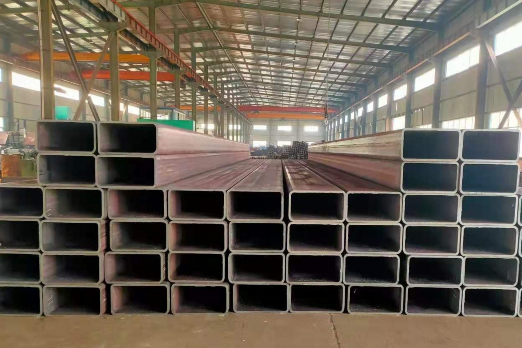
ERW square and rectangular tubes are available in a wide range of sizes, covering applications from small furniture components to large building structures. ▶ Learn more about [Complete Carbon Steel Square Tube Size Chart].
| Parameter | Square Tube (SHS) | Rectangular Tube (RHS) |
|---|---|---|
| Side Length / H×B Range | 20×20 mm – 500×500 mm | H: 20–600 mm, B: 10–400 mm |
| Wall Thickness Range | 0.8 – 16 mm | 0.8 – 16 mm |
| Typical Lengths | 6 m or 12 m (custom available) | 6 m or 12 m (custom available) |
| Common Aspect Ratio (H:B) | 1:1 | Typically up to 4:1 or 5:1 (e.g., 400×100mm) |
| Classification | Size Range | Wall Thickness | Typical Applications |
|---|---|---|---|
| Small / Light | Side/H ≤ 80 mm | ≤ 3.0 mm | Furniture, decorations, small brackets, display racks |
| Medium / Structural | Side/H 80–200 mm | 3.0 – 8.0 mm | Mechanical structures, building trusses, agricultural greenhouses, general frames |
| Large / Heavy | Side/H ≥ 200 mm | ≥ 6.0 mm | Main beams and columns in large buildings, bridges, heavy machinery |
Note: The same production process is used for both square and rectangular tubes. Square tubes are specified by side length × side length (e.g., 100×100mm), while rectangular tubes are specified by height × width (e.g., 100×50mm).
ASTM A500: Primarily used in American standard projects, it is the commonly used structural tube standard in North America.
EN 10219: Applicable to European standard projects.JIS G3466: Applicable to Japanese standard projects.
▶ For detailed information, please refer to the [ASTM A500 standard specification] or [EN 10219 S235JRH and S355J2H Structural Steel].
● Seamless steel pipe: Has no welds and is made by perforating round steel. Theoretically, it has better pressure uniformity and is suitable for higher pressure applications, but it also comes at a higher cost.
● ERW welded pipe: Has a longitudinal weld seam. In most structural and low- to medium-pressure fluid transportation applications, its performance is fully sufficient to replace seamless steel pipe, offering an outstanding price-performance ratio.
6. Logistics and Warehousing: Used in the manufacture of shelves, storage cages, and logistics conveying equipment.
Q1: What is the main difference between ERW welded tube and seamless tube?
A: ERW tubes have a longitudinal weld seam and are produced by forming and welding steel strip. They are highly cost-effective for most structural applications. Seamless tubes are manufactured without any weld seam, offering more uniform pressure resistance, but at a significantly higher cost. For general structural and low-to-medium pressure uses, ERW tubes are usually the more practical choice. Learn more about [ERW Pipe vs. Seamless Pipe Cost].
Q2: What is the standard length for ERW square tubes?
A: The most common standard lengths are 6 meters and 12 meters. However, many manufacturers also offer custom cutting services to meet specific project requirements.
Q3: Can ERW square and rectangular tubes be galvanized?
A: Yes. Like other steel tubes, ERW square and rectangular tubes can be hot-dip galvanized to improve their corrosion resistance, making them suitable for outdoor applications such as agricultural greenhouses, fences, and outdoor structures.
Q4: What is the difference between square tube (SHS) and rectangular tube (RHS) in structural design?
A: The key difference lies in their mechanical properties. Square tubes have equal stiffness in all directions, making them ideal for columns. Rectangular tubes have a "strong axis" and a "weak axis"; when oriented correctly (with the long side vertical), they offer much higher bending efficiency as beams, while saving space.
Q5: How do I choose between the different standards?
A: The choice depends on your project location. Use ASTM A500 for projects that need to meet American standards, EN 10219 for European projects, and GB/T 6728 for Chinese projects.
ERW square tubes and rectangular tubes, due to their high efficiency, cost-effectiveness, high dimensional accuracy, and excellent weld quality, have become an indispensable material in numerous fields, particularly the construction and machinery industries. They are a highly effective alternative to seamless steel pipes in many low- and medium-pressure applications.
Read more:
● Galvanized Square & Rectangular Tube
● EN 10219 Cold-Formed Welded Structural Hollow Sections
Related information
Copyright @2017 Hunan Standard Steel Co.,Ltd and Husteel Industry Group All Rights Reserved