sales@hu-steel.com
 English
 Español
In modern industrial production, carbon steel pipes are widely used in construction, machinery, chemical industries, and other fields. Accurate weight calculation is crucial for material procurement, transportation, and installation. Therefore, understanding how to calculate the weight of carbon steel pipes is essential for professionals in this field.
So, how do you calculate the weight of carbon steel pipes (CS pipes)?
The most commonly used and accurate formula is:
Weight (kg) = (Outer Diameter − Wall Thickness) * Wall Thickness (mm) * 0.02466 * Length (m)
Where:
0.02466: This is a constant derived from the density of carbon steel (approximately 7.85 g/cm³) and unit conversion. This constant only applies to carbon steel and ordinary alloy steel. For stainless steel (density approximately 7.93), the constant is 0.02491.
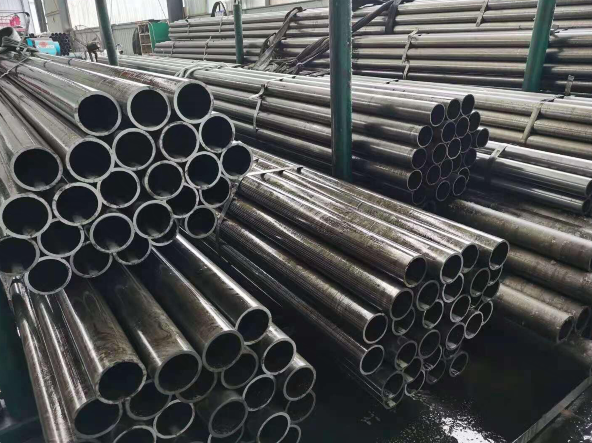
Taking a common carbon steel pipe with Φ114.3mm (outer diameter) × 6.02mm (wall thickness) × 6m (length) as an example:
Theoretical weight approximately: (114.3-6.02)*6.02*0.02466*6 = 96.73kg
Other practical methods and tools:
Besides manual calculation, you can also quickly obtain the weight using the following methods:
1. Online calculator or mobile app: Search for "steel pipe weight calculator," enter the outer diameter, wall thickness, and length, select the material (carbon steel), and you will get the result instantly. This is the fastest way.
2. Consult Standard Weight Tables
For standard-specification seamless steel pipes or welded pipes, you can directly consult national standards or theoretical weight tables provided by the manufacturer. This is the most authoritative and accurate method.
For example, in weight tables, the weight per meter of a DN100, Sch40 carbon steel seamless pipe is usually directly marked as approximately 16.1 kg/m. Therefore, the weight of a 6-meter length would be 16.1 × 6 = 96.6 kg, which closely matches our calculation result.
Things to note when calculating the weight of carbon steel pipes:
3. In practical applications, the weight of carbon steel pipes is also affected by other factors, such as welding, corrosion, inner wall wear, etc., which need to be comprehensively considered based on specific conditions.
4. Clarify Size Definitions: Make sure you are using the outer diameter × wall thickness. In engineering, pipe specifications are commonly expressed in DN (nominal diameter), which is not equal to the outer diameter. A conversion table is required (e.g., DN100 corresponds to an outer diameter of 114.3 mm).
5. Material Influence: The constant 0.02466 in the formula only applies to carbon steel. When calculating for stainless steel, copper, or aluminum pipes, the density constant of the corresponding material must be used.
The importance of steel pipe weight per meter:
Understanding the weight per meter of steel pipe is crucial for the following aspects:
1. Project Design: Accurately calculating the weight per meter of steel pipe is essential for determining the strength and stability of the structure when designing building or engineering projects. Inaccurate weight estimates can lead to project failure or safety hazards.
2. Transportation Costs: The weight of steel pipe directly impacts transportation costs. Knowing the weight per meter helps project managers or logistics personnel plan transportation routes effectively, reducing expenses.
3. Installation Efficiency: The weight of steel pipe also affects work efficiency during construction. Heavier steel pipes may require more manpower and equipment for installation, while lighter steel pipes can improve construction efficiency.
Applications of carbon steel pipes:
Carbon steel pipes are widely used in construction, petroleum, chemical industry, machinery, ships, automobiles, aviation and many other fields. It is characterized by high strength, good corrosion resistance, excellent processing performance, light weight, low cost, etc. It plays an important role in various industries.Through the introduction of this article, I believe everyone has mastered how to calculate the weight of carbon steel pipes. In practical applications, in order to ensure the accuracy of calculations, it is recommended to use more accurate measurement tools as much as possible and take comprehensive considerations into consideration based on specific circumstances.
Read more: Carbon steel tube vs Stainless steel tube
Related information
Copyright @2017 Hunan Standard Steel Co.,Ltd and Husteel Industry Group All Rights Reserved