sales@hu-steel.com
 English
 Español
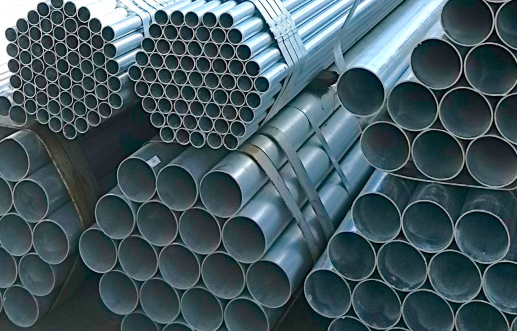
In engineering projects, hot-dip galvanized carbon steel pipe is widely used in fire protection systems, water supply, gas pipelines, and structural applications due to its excellent corrosion resistance. Unlike black carbon steel pipe, the zinc coating adds measurable weight that must be accounted for in cost estimation, transportation planning, and installation design. This article provides systematic guidance on calculating galvanized carbon steel pipe weight, with reliable references to both Chinese and American standards.
The weight difference comes from the zinc coating applied during the hot-dip galvanizing process. Under Chinese standard GB/T3091-93, the average weight of the zinc coating shall be no less than 500 g/m², with no individual specimen less than 480 g/m² . This coating adds approximately 3% to 6% to the base pipe weight, depending on wall thickness.
The theoretical weight of the base pipe (before galvanizing) is calculated using the standard carbon steel pipe weight formula:
W_black = 0.02466 × (D − S) × S
Where:
W_black: Base pipe weight per meter (kg/m)
D: Outside diameter (mm)
S: Wall thickness (mm)
0.02466: Density constant for carbon steel (based on 7.85 g/cm³)
This formula applies to both seamless and welded carbon steel pipe in accordance with ASME B36.10M .
Step 2: Apply Zinc Coating Weight Coefficient
W_galvanized = W_black × C
Where C is the zinc coating weight coefficient. According to industry reference data, the coefficient varies by wall thickness (source: industry reference tables for hot-dip galvanized steel pipe weight calculation) :
|
Wall Thickness (mm) |
Coefficient C |
| 2.0 | 1.064 |
| 2.5 | 1.051 |
| 2.8 | 1.045 |
| 3.2 | 1.040 |
| 3.5 | 1.036 |
| 3.8 | 1.034 |
| 4.0 | 1.032 |
| 4.5 | 1.028 |
Take a common DN50 (2-inch) hot-dip galvanized carbon steel pipe per GB/T3091 with outside diameter 60.3mm and wall thickness 3.8mm .
W_black = 0.02466 × (60.3 − 3.8) × 3.8
= 0.02466 × 56.5 × 3.8
= 5.29 kg/m
Step 2: Coefficient for 3.8mm wall thickness = 1.034
Step 3: Galvanized pipe weight
W_galvanized = 5.29 × 1.034 = 5.47 kg/m
Result: DN50 hot-dip galvanized carbon steel pipe weighs approximately 5.47 kg/m, with a 6-meter length weighing about 32.8 kg.
This matches the GB/T3091-2001 standard table value of 5.607 kg/m for DN50 galvanized pipe , confirming the reliability of this calculation approach.
Based on GB/T 3091-2001 Welded steel pipes for low-pressure fluid delivery (the latest version is GB/T 3091-2015, but weight tables are consistent across versions), the following table provides standard weights for commonly used hot-dip galvanized carbon steel pipe :
| Nominal Size | Inch | OD (mm) | WT (mm) | Weight (kg/m) | 6m Length (kg) |
|---|---|---|---|---|---|
| DN15 | 1/2" | 21.3 | 2.8 | 1.357 | 8.14 |
| DN20 | 3/4" | 26.9 | 2.8 | 1.76 | 10.56 |
| DN25 | 1" | 33.7 | 3.2 | 2.554 | 15.32 |
| DN32 | 1.25" | 42.4 | 3.5 | 3.56 | 21.36 |
| DN40 | 1.5" | 48.3 | 3.5 | 4.10 | 24.60 |
| DN50 | 2" | 60.3 | 3.8 | 5.607 | 33.64 |
| DN65 | 2.5" | 76.1 | 4.0 | 7.536 | 45.21 |
| DN80 | 3" | 88.9 | 4.0 | 8.88 | 53.28 |
| DN100 | 4" | 114.3 | 4.0 | 11.53 | 69.18 |
|
|
|||||
Source: GB/T 3091-2001 standard table values. Actual weights may vary within manufacturing tolerances (permitted deviation per GB/T 3091-2015 is ±7.5% for single pipe and ±5% for batch average). For bulk transactions, actual weighing is recommended for settlement.
For projects following American standards, there is no direct "galvanized pipe weight" table in ASME or ASTM standards. The recommended approach is:
| NPS | OD (mm) | Sch 40/STD (kg/m) | Sch 80/XS (kg/m) |
|---|---|---|---|
| 1/2" | 21.3 | 1.27 | 1.62 |
| 3/4" | 26.7 | 1.69 | 2.20 |
| 1" | 33.4 | 2.50 | 3.24 |
| 1-1/4" | 42.2 | 3.39 | 4.47 |
| 1-1/2" | 48.3 | 4.05 | 5.41 |
| 2" | 60.3 | 5.44 | 7.48 |
| 2-1/2" | 73.0 | 8.63 | 11.41 |
| 3" | 88.9 | 11.29 | 15.27 |
| 4" | 114.3 | 16.07 | 22.32 |
| Source: ASME B36.10M. STD matches Sch 40 for NPS 1/2 to 10; XS matches Sch 80 for NPS 1/2 to 8. | |||
Source: ASME B36.10M carbon steel pipe weight chart . STD (Standard) matches Sch 40 for NPS 1/2 through NPS 10; XS (Extra Strong) matches Sch 80 for NPS 1/2 through NPS 8 .
To estimate galvanized weight for ASTM A53 pipe: multiply the base pipe weight from the table above by a coefficient of 1.03 to 1.06 (use higher coefficient for thinner walls). For example, NPS 2, Sch 40 base pipe weighs 5.44 kg/m; with a 1.05 multiplier, the estimated galvanized weight is 5.71 kg/m.
For GB/T3091 galvanized carbon steel pipe: Use the formula W = C × 0.02466 × (D−S) × S with the wall thickness coefficient table provided above, or consult the GB/T3091 standard weight table directly.
For ASTM A53 / ASME B36.10M galvanized pipe: There is no direct standard weight table. Start with the base pipe weight per ASME B36.10M, then apply a zinc coating multiplier of approximately 1.03 to 1.06 based on wall thickness.
For accurate cost estimation and procurement, always confirm the applicable standard and request actual weighing for large quantity orders.
Related information
Copyright @2017 Hunan Standard Steel Co.,Ltd and Husteel Industry Group All Rights Reserved