sales@hu-steel.com
 English
 Español
1. High-Frequency Resistance Welding (HFW/ERW)
Utilizes the skin effect and proximity effect of high-frequency current to rapidly heat the edges of the steel strip to a molten state, achieving solid-state joining through pressure from extrusion rollers. No welding wire is used, resulting in high efficiency.
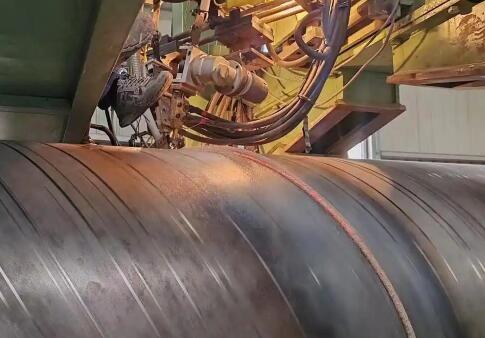
2. Submerged Arc Welding (SAW)
The electric arc burns under a layer of granular flux. The flux melts to form slag and gas, protecting the molten pool and weld metal. It produces deep weld penetration and high quality, used for straight seam (LSAW) and spiral seam (SSAW) steel pipes.
3. Tungsten Inert Gas Welding (TIG/GTAW)
Uses a non-fusible tungsten electrode as the welding electrode, generating an arc under the protection of an inert gas (such as pure argon). This melts the base metal and may or may not be filled with welding wire. High-quality welds are produced, often used for root pass welding or thin-walled pipes.
4. Gas Metal Arc Welding (GMAW)
Uses a fusible welding wire as the welding electrode, performing welding under the protection of a gas (such as CO2 or an Ar+CO2 mixture). The welding processes are categorized as follows:
5. Plasma Arc Welding (PAW)
Utilizes a water-cooled nozzle to compress the arc, obtaining a high-energy-density plasma arc for welding, resulting in strong penetration, suitable for stainless steel, titanium alloys, etc.
6. Brazing
Brazing is not a fusion welding or pressure welding process, but an independent joining technique. It uses a filler metal with a melting point lower than the base metal, heated until the filler metal melts while the base metal does not, filling the joint gap through capillary action to achieve a connection. Induction brazing is commonly used for copper pipe connections.
Read more: Welded steel pipe production process or Installation precautions for welded pipes
Related information
Copyright @2017 Hunan Standard Steel Co.,Ltd and Husteel Industry Group All Rights Reserved