sales@hu-steel.com
 English
 Español

DIN 30670 is the German standard for polyethylene (PE) coatings on steel pipes and fittings – requirements and testing. It defines the performance and testing requirements for factory-applied PE coatings used to protect buried or submerged steel pipelines.
DIN 30670 applies to factory-applied three-layer extruded polyethylene-based coatings, as well as one- or multi-layer sintered polyethylene-based coatings. The standard covers longitudinally welded, spirally welded, or seamless steel pipes, and fittings used in pipelines conveying liquids or gases. It is suitable for design temperatures from –40°C to +80°C.
The standard ensures that the PE coating provides sufficient protection against mechanical, thermal, and chemical loads during operation, transport, storage, and installation.
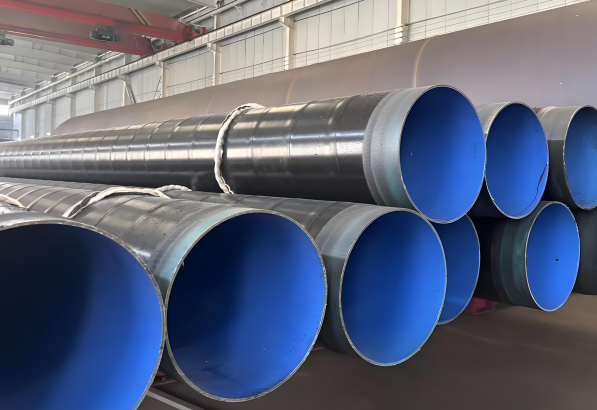
DIN 30670 covers three-layer extruded PE (3PE/3LPE Coating), single-layer sintered PE, and multi-layer sintered PE. Two-layer PE (2PE Coating) is not covered by DIN 30670; it is standardized separately in DIN EN 10288.
Two-layer PE coatings are standardized at European level in DIN EN 10288 (published December 2003).
Rust must be removed by blast cleaning. Blast cleaning and any necessary subsequent work must not reduce the minimum wall thickness specified in the technical delivery standards for the steel pipe. Residual abrasive dust must be removed before coating. Coating materials are selected at the discretion of the coater, unless the purchaser specifies otherwise.
DIN 30670 ensures reliable corrosion protection for buried and submerged steel pipes. It covers coating performance under mechanical, thermal, and chemical loads. It remains the key standard for water and wastewater pipelines, and complements ISO 21809-1 for oil and gas applications.
Coating types: 3-layer extruded PE, sintered PE.
Application: factory-applied.
Substrate: welded or seamless steel pipes and fittings.
Temperature range: –40°C to +80°C.
Surface preparation: blast cleaning.
Related standards: DIN EN ISO 21809-1 (oil & gas), DIN EN 10288 (2PE).
Q: Is DIN 30670 the same as ISO 21809-1?
A: No. ISO 21809-1 covers 3-layer PE/PP coatings for oil and gas pipelines. DIN 30670 also covers water/wastewater, distribution pipelines, and sintered PE coatings.
Q: Does DIN 30670 cover 2PE coating?
A: No. Two-layer PE coatings are standardized in DIN EN 10288.
Q: What is the temperature range (DIN 30670)?
A: –40°C to +80°C.
Q: Which pipes are covered?
A: Longitudinally welded, spirally welded, and seamless steel pipes, plus fittings.
Related information
Copyright @2017 Hunan Standard Steel Co.,Ltd and Husteel Industry Group All Rights Reserved