sales@hu-steel.com
 English
 Español
What is 3PE Spiral Steel Pipe?
3PE Spiral welded steel pipe is a steel pipe with an 3PE anti-corrosion coating manufactured using a spiral submerged arc welding process. Steel coils are rolled into pipe blanks at a specific spiral angle (forming angle), and then internal and external welds are welded. Its characteristics include large diameter, high strength, good flexibility, and outstanding cost-effectiveness.
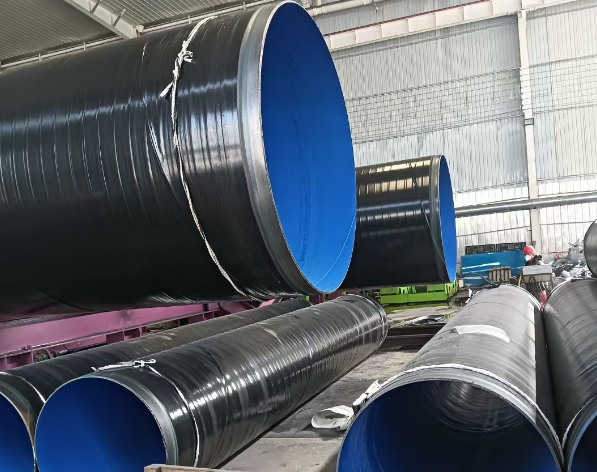 3PE anti-corrosion coating:
It is currently recognized globally as one of the most mainstream and highest-performing external anti-corrosion systems for pipelines.
Its structure is as follows:
First layer: Fusion-bonded epoxy powder: Provides excellent adhesion and cathodic disbondment resistance.
Second layer: Adhesive: Acts as a bond, connecting the underlayer and toplayer.
Third layer: Extruded polyethylene: Provides excellent mechanical protection (impact resistance, scratch resistance) and a long-lasting physical barrier.
The combination of these two layers combines the structural advantages of spiral welded steel pipes with the anti-corrosion advantages of 3PE coating.
Applications in Oil and Gas Pipelines:
3PE spiral welded steel pipes cover almost all applications in long-distance onshore pipelines:
1. Long-Distance Gas Pipelines
Applications: Such as China's "West-East Gas Pipeline" and other national trunk networks and provincial branch networks.
Reasons: Spiral welded steel pipes can be produced in large diameters (up to Φ3620mm in China), meeting the demand for large-volume transmission; the 3PE coating provides a design life of over 50 years and can withstand complex soil environments and damage from third-party construction.
2. Long-Distance Oil Pipelines
Applications: Trunk pipelines transporting crude oil and refined oil.
Reasons: Good mechanical strength and economy; the 3PE coating effectively prevents corrosion of the pipe body by soil and groundwater.
3. Gathering and Transmission Networks
Applications: Pipelines that collect and transport the products from various wellheads in oil and gas fields to processing stations.
Reasons: Flexible pipe diameter range, adaptable to terrain changes; the 3PE coating resists chemical corrosion that may exist in oilfield areas.
4. Crossing Projects
Applications: Directional drilling or pipe jacking crossings of rivers, highways, and railways.
Reasons: Spiral steel pipes have high weld strength, and the 3PE coating exhibits excellent scratch resistance and wear resistance during pullback, effectively protecting the pipe body.
Why has 3PE Spiral Steel Pipe Become the Mainstream Choice?
The spiral process easily enables the production of large-diameter, thick-walled pipes, with high material utilization and significantly lower costs than straight-seam submerged arc welded pipes of the same specifications, making it ideal for large-scale trunk line construction.
3PE anti-corrosion steel pipes are crucial for the service life of buried pipelines. Pipes of the same material buried underground for decades may not corrode, while others may leak after only a few years. This is because they use different outer coatings.
In harsh environments such as rocky areas, areas with high soil stress, high groundwater levels, and the risk of third-party damage, 3PE anti-corrosion steel pipes perform far better than single-layer FBE coated steel pipes.
3PE anti-corrosion steel pipe insulation performance is good, heat loss is only 25 per cent of the traditional pipe, long run can save relatively large resources, significantly reduce energy costs, and still has a relatively strong waterproof and corrosion resistance, and has no need trench directly on the ground or water can be purchased, but also easily and quickly on the construction, relatively low cost integrated, also at low temperatures and has good corrosion resistance, impact resistance, and in certain circumstances You can also directly embedded in permafrost.
3PE SSAW pipe vs. 3PE LSAW pipe: How to Choose?
In oil and gas pipelines, 3PE spiral welded steel pipe (SSAW) and 3PE straight seam submerged arc welded pipe (LSAW) are the main competitors. The following factors need to be considered when choosing between them:
3PE SSAW Pipe:
Formed by continuously coiling steel strip into a spiral shape, with only one spiral weld seam. Its advantages include low cost, large diameter, and good flexibility, but residual stress exists during forming. It is suitable for the main body of cost-sensitive, terrain-varying long-distance land pipelines, mostly in medium to large diameters.
3PE LSAW Pipe:
Formed directly from steel plate into a pipe (JCOE/UOE process), with one or two straight weld seams. Its advantages include more uniform and stable weld quality, lower residual stress, and higher dimensional accuracy, but its cost is higher, especially in the field of large-diameter, thick-walled pipes. It is suitable for high-pressure, high-risk pipeline sections (such as inlets and outlets, crossing core sections), subsea pipelines, extreme environments such as extremely cold regions, and ultra-thick wall requirements.
Therefore, 3PE spiral welded steel pipe is the primary pipe type for the vast majority of long-distance land pipelines due to its overall cost-effectiveness. However, 3PE straight seam pipe is selected for critical safety points, special environments, or when the owner has specific requirements.
Limitations and Development:
a. Temperature Limitations: The polyethylene layer generally has a temperature resistance of ≤80℃, therefore 3PE is not suitable for high-temperature oil pipelines (these pipelines mostly use 3PP or double-layer FBE).
b. On-site Jointing: This remains a weak point, requiring meticulous construction using heat-shrinkable tape/sleeves or solvent-free liquid epoxy + polypropylene wrapping tape to ensure equivalence with the main coating.
c. Environmental Trends: While the 3PE coating itself is environmentally friendly, greening the production and recycling processes is a sustainable development direction.
Read more: Carbon Steel vs Black Steel
Related information
Copyright @2017 Hunan Standard Steel Co.,Ltd and Husteel Industry Group All Rights Reserved