sales@hu-steel.com
 English
 Español
Mechanical tubing refers to seamless or welded tubes (ERW and DOM) manufactured to precise dimensional tolerances, specifically intended for mechanical and structural applications — not for fluid transport. It is a product form defined by its dimensional accuracy, surface finish, and mechanical properties, rather than by its pressure-containing capability.
A mechanical piping system is an integrated assembly of pipes, valves, fittings, and support components designed to transport fluids or gases within mechanical equipment and industrial facilities. Unlike precision steel products utilized as structural or machined components, a piping system functions as a complete operational unit responsible for controlling the flow rate, pressure, and direction of the medium throughout the process.
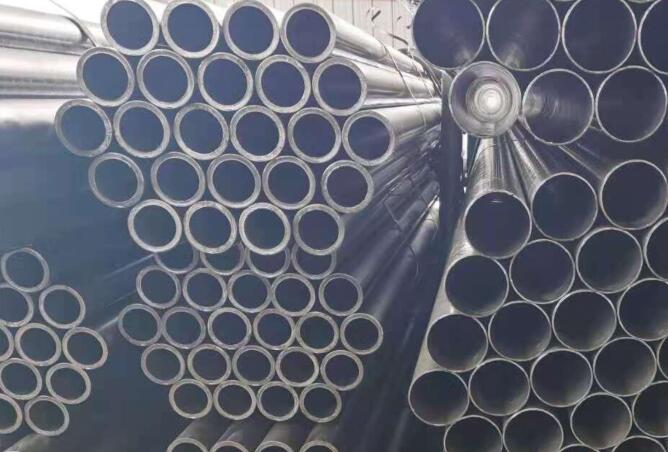
Mechanical tubing is produced in several forms, each suited to different applications:
| Type | Common Standard | Manufacturing Process | Key Characteristics | Typical Applications |
|---|---|---|---|---|
| ERW Mechanical Tubing | ASTM A513 Type 1/2 | Electric resistance welded from hot-rolled or cold-rolled steel | Cost-effective, good dimensional accuracy | Furniture frames, racks, general structures |
| DOM (Drawn Over Mandrel) | ASTM A513 Type 5 | ERW tube cold-drawn over a mandrel | Superior surface finish, tight tolerances, uniform wall | Hydraulic cylinders, shock absorbers, precision shafts |
| Seamless Mechanical Tubing | ASTM A519 | Hot-rolled or cold-drawn from solid billet | No weld seam, uniform strength; cold-drawn grades offer tighter tolerances and better surface finish | High-pressure hydraulic systems, precision machinery, instrumentation |
▶ For detailed specifications on ERW mechanical tubing, see our [ERW Pipe Wall Thickness Size Chart].
The working environment determines the material and manufacturing requirements. The table below combines both considerations for direct reference:
| Environment | Recommended Material | Recommended Type | Reason |
|---|---|---|---|
| Normal temperature, non-corrosive | Carbon steel (1010, 1020) | ERW or DOM | Cost-effective, adequate performance |
| High pressure (hydraulic systems) | Carbon steel (1020, 1026) | DOM or Seamless | No weld seam, uniform strength |
| High temperature | Carbon or alloy steel (4130) | Seamless | Better thermal stability |
| Corrosive media | Stainless steel (304, 316) | Seamless or DOM | Superior corrosion resistance |
| Low temperature | Killed carbon steel or alloy | Seamless | Good low-temperature impact toughness |
Common material grades and their applications:
● Carbon Steel (1010, 1015, 1020, 1026): Good formability, weldability, and machinability. Used for general mechanical parts, furniture, and automotive components.
● Alloy Steel (4130, 4140, 8620): Higher strength and hardenability. Used for high-stress components such as gears and shafts.
● Stainless Steel (304, 316, 304L, 316L): Corrosion and high-temperature resistance. Used in chemical equipment, medical devices, and food machinery.
▶ For chemical composition and mechanical properties of ASTM A513 grades, see our [ASTM A513 Mechanical Tubing Guide] .
Mechanical tubing is specified by outside diameter (OD) × wall thickness (WT). Tolerances vary by manufacturing process:
| Manufacturing Process | Typical OD Range | Typical WT Range | Tolerance Level |
|---|---|---|---|
| ERW (Hot-Rolled) | 1/2" – 15" | 0.065" – 0.650" | Standard commercial |
| ERW (Cold-Rolled) | 3/8" – 12" | 0.022" – 0.134" | Tighter than hot-rolled |
| DOM | 1/4" – 12" | 0.028" – 0.500" | Very tight, uniform wall |
| Cold-Drawn Seamless | 1/8" – 5" | 0.012" – 0.500" | Tightest available |
Selection tip: For precision applications (hydraulic cylinders, bearings), always specify DOM or cold-drawn seamless tubing — the tighter tolerances and superior surface finish justify the higher cost.
For general structural use, standard ERW mechanical tubing surface finish is acceptable. For hydraulic or pneumatic sealing applications, DOM or cold-drawn seamless tubing is required because the smooth inner surface is critical for seal life. For coating or painting, any type with surface preparation works, but a smoother surface improves coating adhesion. For precision machining, cold-drawn seamless or DOM reduces machining time due to tighter tolerances.
Selection principle: Select the lowest-cost tubing that meets requirements for dimensions, surface quality, and performance. For most non-critical applications, ERW (Electric Resistance Welded) mechanical tubing suffices; however, precision or high-pressure applications require DOM (Drawn Over Mandrel) or seamless tubing.
| Industry | Application Examples | Recommended Type |
|---|---|---|
| Hydraulic Systems | Hydraulic cylinders, pneumatic actuators, shock absorbers | DOM or seamless |
| Automotive | Drive shafts, steering columns, axle housings, chassis components | DOM, seamless, or ERW |
| Machinery Manufacturing | Conveyor rollers, printing rollers, textile machinery parts | ERW or DOM |
| Furniture & Fixtures | Chair frames, table legs, display racks, shelving | ERW mechanical tubing |
| Construction | Scaffolding, handrails, structural supports | ERW mechanical tubing |
| Precision Instruments | Sensor housings, bearing retainers, medical equipment | Cold-drawn seamless |
| Energy & Petrochemical | Heat exchanger tubes, boiler tubes, process piping | Seamless (ASTM A519, A213) |
Q1: What is the difference between mechanical tubing and pipe?
A: Mechanical tubing is specified by exact OD and wall thickness and is used for mechanical and structural applications. Pipe is specified by nominal pipe size (NPS) and schedule and is used for fluid transport. Tolerances for mechanical tubing are generally tighter.
Q2: How do I choose between ERW, DOM, and seamless mechanical tubing?
A: It depends on your application:
● General structural use → ERW mechanical tubing (cost-effective)
● Hydraulic cylinders, precision parts → DOM tubing (tight tolerances, smooth surface)
● High pressure, critical applications → Seamless tubing (no weld seam, uniform strength)
Q3: What tolerances can I expect from mechanical tubing?
A: ERW: commercial tolerances.
DOM: ±0.005" or better on OD, uniform wall.
Cold-drawn seamless: tightest tolerances, often ±0.002" or better. Always specify tolerances when ordering.
Q4: Can mechanical tubing be welded?
A: Yes. Carbon steel and alloy steel mechanical tubing is weldable. Alloy grades (4130, 4140) may require preheating and post-weld heat treatment. Stainless steel grades (304, 316) are also weldable with appropriate filler.
Q5: What is the maximum length of mechanical tubing?
A: Standard lengths are 20 ft (6m) or 40 ft (12m). Longer lengths may be available depending on size and manufacturing process. Custom cut lengths are available.
Further Reading
[Mechanical Tubing vs. Structural Tubing]
[ASTM A519 Seamless Mechanical Tube]
[Mechanical Tube Purchasing Guide]
[Seamless Steel Pipe Manufacturing Process]
[Cold Drawn Seamless Tube Size Chart for Mechanical and Hydraulic]
Related information
Copyright @2017 Hunan Standard Steel Co.,Ltd and Husteel Industry Group All Rights Reserved