Seamless Tube Forming Process: From Solid Steel Billet to Precision Tube
Seamless tubes (SMLS tube), due to their seamlessness, uniform material, and high pressure resistance, are widely used in high-pressure boilers, petrochemicals, aerospace, and precision machinery. Unlike welded tubes, seamless tubes are made by processing solid steel billets into hollow tubes, without any welding processes involved in the entire production process. This article will analyze the mainstream forming processes of seamless tubes in detail.
3 Core Manufacturing Methods of Seamless Tubes:
The production processes of seamless tubes are mainly divided into three categories: hot rolling, cold rolling/cold drawing, and extrusion. Among them, hot-rolled tubes account for approximately 80%-90% of the global seamless tube production. Different processes are suitable for different materials, specifications, and application scenarios.
1. Hot-Rolled Seamless Tube Process
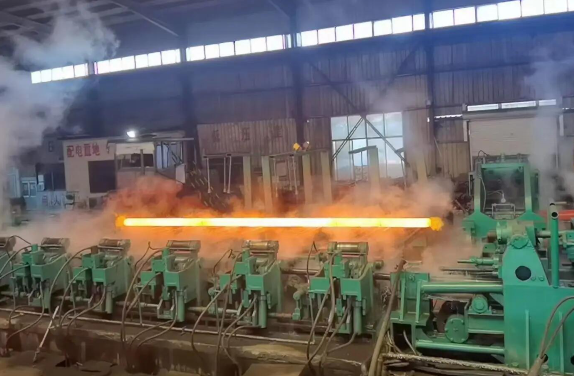
Hot rolling is the most important production method for seamless tubes, especially suitable for mass production of medium and large diameter tubes. The entire process is carried out at high temperatures, where the metal has good plasticity.
Step 1: Billet Preparation and Heating
Production begins with a solid round steel billet. The steel billet undergoes rigorous flaw detection (such as ultrasonic testing) to ensure it is free of internal cracks, inclusions, and other defects. Qualified billets are then fed into a walking beam furnace and heated to 1100-1250℃, giving the metal good plasticity.
Step 2: Piercing – The Core Forming Process
Piercing is crucial in seamless tube manufacturing and represents the most technologically advanced stage. The mainstream process is the Mannesmann process, invented by the Mannesmann brothers in Germany in 1885.
This process uses two angled rollers to rotate the billet at high speed while a conical mandrel is inserted into the center. The combined effect of rotation and the mandrel generates significant tensile stress within the billet, causing it to naturally crack along its center, forming a hollow "capillary tube" (raw tube). This skewed rolling piercing method is highly efficient and achieves one-step forming, forming the foundation of the modern seamless steel tube industry. The Mannesmann process remains the core technology for seamless tube production worldwide.
Step 3: Tube Rolling and Extension
The pierced tube has a relatively thick wall and short length, requiring further rolling. Common methods include:
● Continuous Rolling: This process involves continuous rolling over multiple stands, using a long mandrel to gradually reduce the diameter and wall thickness. It offers high dimensional accuracy and is suitable for mass production.
● Assel Rolling (Three-Roll Skew Rolling): Utilizing the coordinated movement of three rolls and a mandrel, this method is particularly suitable for processing thick-walled tubes and effectively ensures uniform wall thickness.
● Pilgering: A periodic tube rolling process suitable for processing large-diameter, thick-walled, or difficult-to-deform alloy tubes.
Step 4: Sizing and Finishing
The rolled tube is then further sizing to precisely control its outer diameter, achieving an accuracy of ±0.1mm. Following straightening and cutting, heat treatment (such as normalizing, tempering, or solution treatment) is performed as needed to optimize mechanical properties.
2. Cold Rolling and Cold Drawing Processes
For seamless tubes requiring high dimensional accuracy, excellent surface finish, or small diameter, thin wall thickness, cold working is usually required after hot rolling.
● Cold Rolling: The outer diameter and wall thickness of the tube are gradually reduced using a reciprocating rolling mill. This results in significant metal deformation, significantly refining the grain size and increasing strength, while achieving extremely high dimensional accuracy and smooth inner and outer surfaces.
● Cold Drawing: One end of the tube is reduced in diameter and then forcibly drawn through a die and internal mandrel slightly smaller than its outer diameter. Cold drawing effectively improves the dimensional accuracy and surface quality of the tube and can produce extremely fine capillaries. Cold drawing is often used in conjunction with cold rolling; for example, cold rolling to reduce wall thickness followed by cold drawing to obtain various specifications.
Key auxiliary processes: After each cold working, the tube undergoes work hardening, necessitating degreasing, cleaning, and annealing (heat treatment) to restore plasticity and prepare for the next stretching. Cold rolling and cold drawing are crucial steps for achieving "precision" in seamless tubes, suitable for high-end applications such as hydraulic cylinder barrels and precision mechanical parts.
3. Extrusion Process
For difficult-to-deform metals such as stainless steel and high-temperature alloys, or when producing tubes with irregular cross-sections, hot extrusion is an ideal forming method. Heated billets are placed in an extrusion cylinder and extruded through a die hole using a high-tonnage hydraulic press, forming the tube in one step. Extrusion produces uniform deformation and can manufacture alloy tubes that are difficult to process using other methods.
Hot Rolling vs. Cold Working: A Comparison of Process Characteristics
Comparison Dimensions
|
Hot-rolled seamless tube
|
Cold-rolled/Cold-drawn seamless tube
|
Processing Temperature
|
Above recrystallization temperature (1100-1250℃)
|
Room temperature
|
Dimensional Accuracy
|
Average (wall thickness tolerance ±10%-12.5%)
|
High (outer diameter tolerance ±0.05mm, uniform wall thickness)
|
Surface Quality
|
With oxide scale, relatively rough
|
Smooth, no oxide layer, Ra≤0.8μm
|
Wall Thickness Range
|
Relatively thick (2.5-75mm)
|
Can be extremely thin (thinnest 0.25mm)
|
Minimum Outer Diameter
|
Usually ≥32mm
|
Can reach below 6mm
|
Mechanical Properties
|
Good overall performance
|
Higher strength (work hardening), Increased surface hardness
|
Applications
|
General fluid pipes, boiler tubes, structural tubes.
|
Precision machinery, hydraulic systems, aerospace.
|
Production Share
|
Approximately 80%-90%
|
Approximately 10%-20%
|
Quality Control and Testing:
To ensure the reliability of seamless pipes, especially for use in high-pressure or corrosive environments, rigorous testing is essential:
● Non-destructive Testing (NDT): Includes ultrasonic testing (UT, for detecting internal defects), eddy current testing (ET, for detecting surface and near-surface defects), and hydrostatic testing to ensure the pipes are free of cracks, inclusions, and other defects that could affect their use.
● Destructive Testing: Samples are taken from representative pipes for tensile, hardness, flattening, and flaring tests to verify mechanical properties.
● Seamless Pipe Dimensioning and Appearance Inspection: Measuring tools, thickness gauges, and visual inspection are used to ensure that the outer diameter, wall thickness, length, and surface quality meet standards.
Development Trends:
The seamless pipe forming process around 2026 will exhibit the following characteristics:
1. Ultimate Excellence: China Henggang's "630 Project" has built the world's largest diameter seamless steel pipe continuous rolling production line, achieving the world's first one-time continuous rolling forming of ultra-large diameter seamless steel pipes.
2. Green Development: HIsmelt's melt reduction technology and integrated solidification-direct rolling technology are striving to reduce reliance on coke and multiple heating processes.
3. Precision and Intelligence: Whether it's Baosteel's digital twin piercing control or SMS's AI quality inspection, data is becoming a core asset for improving wall thickness uniformity and yield.
4. Functionalization and Composite Application: KIT's cold-air spraying additive manufacturing technology breaks the traditional mindset that "steel is metallurgy," opening up new pathways for manufacturing functional seamless tubes with specific internal wall morphologies.
Read more: Seamless Steel Pipe Sizes and Weights
 sales@hu-steel.com
 English
 Español