sales@hu-steel.com
 English
 Español
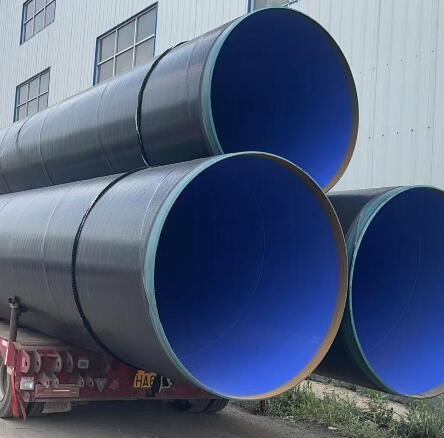 ● Spiral Submerged Arc Welded Steel Pipe (SSAW)
Applicable Scenarios: Main pipelines for large irrigation areas, long-distance water conveyance projects, and high-standard farmland construction.
1. Water Delivery Capacity
Large diameter means a large cross-sectional area, suitable for use as the backbone water delivery pipeline in irrigation areas. The smooth inner wall reduces frictional resistance, allowing for longer distances or reduced pumping station energy consumption at the same head.
2. Structural Strength and Durability
Steel is robust and can withstand internal water pressure and external loads. When buried deep underground, it can withstand soil pressure and dynamic loads from agricultural machinery without easily deforming. The steel pipes require anti-corrosion treatment, such as epoxy coal tar pitch or three-layer PE anti-corrosion coating on the outer wall and food-grade anti-corrosion coating on the inner wall, resulting in a service life of decades.
A regular inspection system needs to be established, utilizing pressure monitoring, corrosion protection layer inspection, and other methods to prevent localized corrosion or third-party damage and to promptly maintain the system.
FAQs:
Q1: Do large-diameter welded steel pipes require internal anti-corrosion treatment?
A: Generally yes. Irrigation water may contain minerals, microorganisms, or be corrosive. Internal anti-corrosion treatment (such as food-grade epoxy coating) can:
a. Prevent internal corrosion and ensure water quality
b. Reduce hydraulic friction resistance and lower energy consumption for water delivery
c. Extend pipeline service life, which is especially crucial for long-term backbone pipeline networks
Currently, the mainstream internal and external anti-corrosion solution is TPEP anti-corrosion (external 3PE, internal fusion-bonded epoxy composite anti-corrosion). The outer wall uses three layers of polyethylene (3PE coating) for anti-corrosion, and the inner wall uses thermally sprayed epoxy powder, with a service life of over 50 years.
Q2: What agricultural irrigation scenarios are suitable for large-diameter welded steel pipes?
A: Primarily suitable for the following scenarios:
● Large-scale irrigation main pipeline networks: Large pipe diameter, strong water conveyance capacity, single pipe water conveyance can reach over 3000 m³/h;
● High-standard farmland construction: Requires durable, maintenance-free pipelines that can be integrated with intelligent control equipment;
● Inter-regional water transfer irrigation projects: Long-distance water conveyance, requiring high pressure resistance and sealing performance;
● Highly corrosive areas (such as saline-alkali land): After proper anti-corrosion treatment, steel pipes can withstand soil corrosion.
For small-scale farmland or temporary irrigation, plastic pipes (PE, PVC) may be a more economical choice.
Q3: What is the approximate price? How to control costs?
A: Prices are affected by factors such as steel market fluctuations, pipe diameter and wall thickness, anti-corrosion requirements, and transportation distance, and are usually priced per ton. Taking conventional Q235B material as an example, the price fluctuates in the range of several thousand yuan per ton. Specific prices need to be inquired based on real-time steel prices and technical specifications. Although the initial investment in plastic-coated steel pipes is higher, the total cost can be reduced by about 40%, and the lifespan is up to 50 years.
Q4: How economical are large-diameter welded steel pipes compared to plastic pipes?
A: Plastic pipes save money now, while welded pipes save money in the future. For large-diameter (DN400 and above) or high-pressure (1.0MPa and above) applications, welded pipes are a more reliable and economical choice.
Q5: Are large-diameter hot-dip galvanized steel pipes suitable for agricultural irrigation?
A: They can be used in low-pressure irrigation applications. There are practical application cases in Zhejiang, China, where large-diameter hot-dip galvanized steel pipes are used for low-pressure irrigation, offering corrosion resistance and durability.
Q6: What is the approximate water delivery capacity of different pipe diameters?
A: Taking TPEP anti-corrosion steel pipes as an example, a single DN1200 diameter pipe can deliver up to 3000 m³/h, sufficient to meet the irrigation needs of large-scale farmland. The specific water delivery capacity needs to be calculated based on the design flow velocity, which is typically 1.0-2.0 m/s.
Conclusion:
Large-diameter welded steel pipes for agricultural irrigation are suitable for large-scale irrigation area expansion projects, high-standard farmland backbone water conveyance systems, and inter-regional water transfer irrigation. While not the most economical option for small-scale farmland, they excel in large-scale water conveyance projects. Selection should be based on a comprehensive comparison with other solutions, taking into account irrigation scale, terrain, water demand, and budget.
Read more: Advantages and Disadvantages of Pipeline Transportation
Related information
Copyright @2017 Hunan Standard Steel Co.,Ltd and Husteel Industry Group All Rights Reserved