Cutting seamless carbon steel pipes is a crucial process in pipe prefabrication, installation, and maintenance. Choosing the correct cutting method is essential, directly impacting cutting efficiency, cut quality, the ease of subsequent processing (such as beveling and welding), and the final cost.
Seamless Carbon Steel Pipe Cutting Methods and Technologies:
In the industrial field, the mainstream cutting methods and technologies for seamless carbon steel pipes mainly include the following, each with its own characteristics and applicable to different scenarios.
1. Thermal Cutting Method
Thermal cutting is suitable for medium-thick walls, large-volume production, and non-precision applications. It utilizes a high-temperature heat source to melt or oxidize the metal to achieve cutting. It is highly efficient, but has a large heat-affected zone.
a. Oxyacetylene/Oxypropane Flame Cutting
Flame cutting involves preheating with a high-temperature flame, then blowing in pure oxygen to violently oxidize (burn) the iron and blow away the molten slag. This method is characterized by simple equipment, lowest operating costs, and portable equipment. However, the heat-affected zone is relatively wide (1-3mm), the cut is uneven and rough with molten slag, and the precision is relatively poor (±1-2mm), requiring secondary processing.
Applicable scenarios: On-site repair, material cutting, rough cutting of thick-walled, large-diameter pipes (≥20mm) where the requirements for cut quality and precision are not high, or as an auxiliary cutting method.
b. Plasma Cutting
Plasma Cutting: This method uses ionized gas to create a high-temperature plasma arc, melting the metal and then blowing it away with a high-speed gas stream. Its advantages include extremely high cutting speed and the ability to cut any conductive metal (including stainless steel and alloy steel). The heat-affected zone is smaller than flame cutting, resulting in a cleaner cut. However, the equipment is more expensive, and it produces noise and smoke. The cut is "V" shaped with a certain angle.
Applicable Scenarios: This method is suitable for efficient cutting of medium-thin walled tubes (≤20mm), especially for difficult-to-cut materials such as
alloy steel and stainless steel. It offers high cutting efficiency, good cut quality, and the ability to cut thicker tube walls, making it suitable for industrial applications with high requirements for material quality and cut quality. Suitable for mass production.
c. Laser Cutting
This method uses a focused high-energy laser beam to irradiate the workpiece, rapidly melting and vaporizing the material. High-pressure assist gas is then used to remove the molten slag. The advantages of this method are high precision (±0.1mm), excellent cut quality, smooth cut, no burrs, minimal heat-affected zone, and the ability to cut complex shapes. The disadvantages are the huge equipment investment, low efficiency in cutting thick-walled pipes, and high cost.
Applicable scenarios: Thin-walled
precision pipes (≤12mm) requiring extremely high precision and cut quality, such as high-precision cutting of hydraulic system pipes, instrument pipes, and automotive pipes.
2. Cold Cutting Method (Also called Mechanical Cutting)
Cold cutting is mainly suitable for applications requiring high precision, high quality, and no heat-affected zone. It removes material through mechanical force without heat input, making it the preferred method for high-quality weld bevel preparation.
a. Sawing Cutting (Band Saw/Circular Saw)
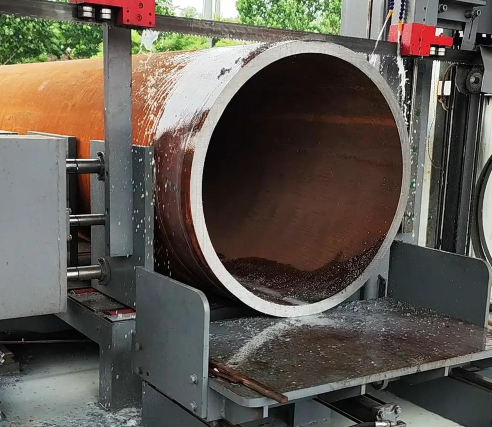
Pipe sawing uses automated, high-speed mechanical saw teeth (alloy saw blades or high-speed steel) to cut the steel pipe. However, high-speed friction generates a large amount of heat, enough to heat, discolor, or even slightly anneal the material at the cut edge, effectively creating a heat-affected zone. Its characteristics are high efficiency, moderate cost, smooth cut, and good dimensional accuracy. However, it produces chips, and the cut may have slight burrs, requiring deburring. Band saws are suitable for large cross-sections, while circular saws are suitable for high-speed batch processing.
Applicable Scenarios: The first choice for large-volume blanking, especially suitable for fixed-length cutting of small and medium diameter seamless pipes. It is standard equipment for
carbon steel seamless pipe manufacturers and pipe processing centers.
b. Lathe/Pipe Cutting Machine Cutting
Lathe cutting refers to end-face cutting on a lathe using carbide or ceramic cutting tools. The cutting heat is carried away by the chips, resulting in extremely low heat input to the workpiece. Its characteristics include extremely high precision (dimensional tolerances up to ±0.05mm) and the best cut end-face quality (smooth, high perpendicularity, can be directly used as a welding bevel). However, efficiency is relatively low, and the equipment is specialized.
Applicable Scenarios: Applications requiring extremely high end-face perpendicularity, smoothness, and fixed-length precision, such as the final blanking of pipes for hydraulic cylinders and precision mechanical parts.
c. Abrasive Wheel Cutting (Grinding Cutting)
Abrasive wheel cutting uses a high-speed rotating fiber-reinforced abrasive wheel for grinding. Its characteristics include simple, portable, and inexpensive equipment, suitable for materials of various hardness. However, it generates a lot of dust and noise, wears the grinding wheel quickly, and produces burn marks and burrs on the cut, with generally lower precision.
Suitable scenarios: Emergency or small-scale cutting at construction sites and repair shops, especially suitable for high-hardness steel pipes or hardened surfaces. It easily produces burrs, requiring grinding, and is suitable for general industrial needs.
d. Cold Sawing
Cold sawing refers to using a slow-speed, large-diameter saw blade with carbide teeth to cut at low speed with enormous shearing force, while a large amount of coolant removes frictional heat. Its characteristics include no heat-affected zone, burr-free and deformation-free cuts, and high precision. However, the equipment is bulky and expensive, mainly used for heavy materials.
Suitable scenarios: Precision cutting of large-diameter pipes with high cut quality requirements and thick walls, commonly found in high-end pipe prefabrication plants.
3. Advanced/Specialized Cutting Technologies
a. Waterjet cutting
Utilizes ultra-high pressure water (or a mixture of abrasives) to form a "water jet" to erode and cut the material. This method involves absolute cold cutting, eliminating the heat-affected zone, and can cut any material with high precision. However, it has high equipment costs, slower speed, higher operating expenses, and produces a slight bevel at the cut.
Suitable for: Cutting pipes that are extremely sensitive to heat or composed of multiple materials, such as steel pipes with anti-corrosion coatings, or special laboratory requirements.
b. CNC pipe cutting (intersection line cutting)
Combining plasma or laser cutting heads with a multi-axis CNC system, it cuts complex weld bevels where pipes intersect according to a preset program. Its advantages are automation and digitalization; it can complete complex intersection lines and bevel processing in one operation, with high precision and efficiency, making it a core technology for modern pipeline prefabrication.
Suitable for: Building steel structures, offshore platforms, and the preparation of all nodes requiring pipe-to-pipe welding in pipeline systems.
Selection Decision Guide:
When choosing a cutting method for seamless carbon steel pipes, please consider the following order:
1. Quality requirements: This is the primary factor.
a. Is direct welding required? → 1. Prefer cold cutting (lathe, cold saw) or high-quality plasma/laser cutting to ensure beveling quality and reduce welding defects.
b. Extremely high dimensional and geometric tolerance requirements? → Choose lathe cutting or laser cutting.
c. Rough cutting only? → Flame cutting or abrasive wheel cutting is sufficient.
2. Pipe Specifications
Wall thickness: Thin walls (<10mm) are best cut with laser, plasma, or band saw; thick walls (>20mm) can be cut with flame, plasma, or cold saw.
Diameter: Small diameter pipes are suitable for band saws and lathes; large diameter pipes require large flame or plasma cutting machines or intersecting line cutting machines.
3. Production Batch and Efficiency
Single piece/repair: Abrasive wheel cutting machine, portable plasma.
Small batch: Band saw, general-purpose plasma.
Large batch/automated production: Automated band saw production line, CNC laser/plasma pipe cutting machine, intersecting line cutting center.
4. Cost Budget
Equipment Investment: From low to high: Grinding wheel → Flame gun → Band saw → Plasma → Laser/waterjet/CNC pipe cutting center.
Single Cutting Cost: Flame cutting is the lowest, waterjet and laser are higher.
Conclusion:
There are three main types of cutting methods for seamless carbon steel pipes: thermal cutting, cold cutting, and advanced technology cutting. When choosing a method, material specifications, precision requirements, and cost factors must be comprehensively considered. For example, sawing is preferred for high-precision applications, while gas cutting can be chosen for mass production.
For modern industrial projects, especially prefabricated pipes involving subsequent welding, cold cutting or high-precision thermal cutting (CNC plasma/laser) is recommended to maximize cut quality and lay a good foundation for subsequent processes. In the long run, this can save more on secondary processing costs and potential rework risks.
Read more: American Standard Seamless Steel Pipe or How to Bend Carbon Steel Pipe?
 sales@hu-steel.com
 English
 Español