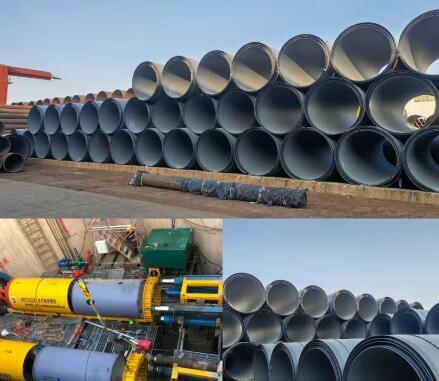
The main cutting methods for spiral steel pipes (SSAW) are as follows:
Mechanical Cutting:
1. Sawing
Principle: Utilizing the relative movement of a saw blade and the steel pipe, the steel pipe is cut through the cutting action of the saw teeth.
Features: High sawing precision, good cut smoothness, adaptable to spiral steel pipes of various diameters. Band sawing is the preferred method for mass production in factories, offering stable cutting quality; circular sawing is faster and suitable for small to medium diameter pipes. For large-diameter steel pipes, band sawing technology is mature and cost-effective.
2. Abrasive Wheel Cutting
Principle: A high-speed rotating abrasive wheel grinds the steel pipe, causing it to separate.
Features: Relatively fast cutting speed, narrower kerf, smaller heat-affected zone. However, the abrasive wheel wears quickly, and a large amount of grinding heat is generated during cutting. This method is mainly suitable for cutting small-diameter spiral steel pipes with an outer diameter less than 200mm and thinner walls; it is less efficient for large-diameter or thick-walled pipes.
Flame Cutting:
1. Oxygen Fuel Cutting (Oxyacetylene/Oxypropane Cutting)
Principle: Utilizes the high-temperature flame generated by the combustion of a mixture of fuel gas and oxygen to heat the steel pipe to its ignition point. Then, a pure oxygen stream is injected, causing the steel pipe to burn intensely and blowing away the molten slag to cut it. In practical applications, propane or natural gas are often used as fuels due to their lower cost.
Features: Simple equipment, low cost, capable of cutting spiral steel pipes with larger diameters. However, the cutting accuracy is relatively poor, and the heat-affected zone of the cut is large, which can cause a hardened layer near the cut and alter the microstructure. If used for pressure pipelines, the beveling needs to be ground or machined after cutting.
2. Plasma Cutting
Principle: Cuts the steel pipe by locally melting and blowing away the molten material using a high-temperature plasma arc.
Features: Fast cutting speed, good cut quality, small heat-affected zone, capable of cutting various metal materials including spiral steel pipes, and can cut thicker pipe walls. Particularly suitable for on-site beveling operations of thick-walled spiral steel pipes (>20mm). However, the equipment cost is relatively high, and the cutting process generates some noise and dust.
Laser Cutting:
1. Principle: A high-energy-density laser beam is used to irradiate the steel pipe, causing the material to melt or vaporize rapidly, thus achieving cutting.
2. Characteristics: Extremely high cutting precision, narrow kerf, minimal heat-affected zone, and almost no impact on the performance of the cut end of the steel pipe. It can achieve automated cutting and high production efficiency. However, the equipment is expensive, and operating costs are high. It is mainly suitable for processing thin-walled, small-to-medium diameter precision pipes, and is less commonly used for large-diameter (over 500mm) and thick-walled (over 15mm) spiral steel pipes commonly used in construction and oil and gas transportation.
Read more: Advantages and Disadvantages of Pipeline Transportation
 sales@hu-steel.com
 English
 Español