sales@hu-steel.com
 English
 Español
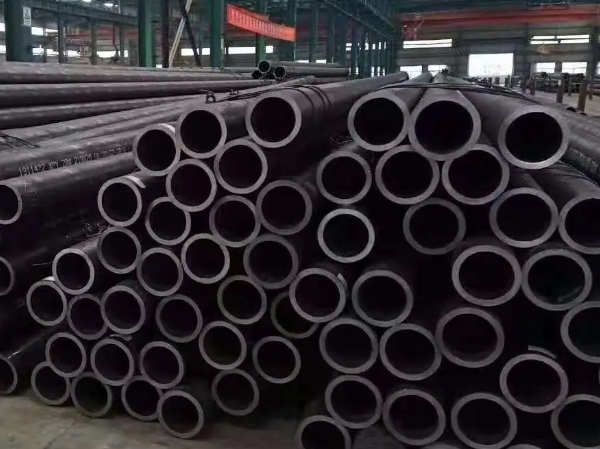
ASTM A106 Gr.B is a seamless carbon steel pipe designed for high-temperature service. It is widely used in petrochemical, power generation, and boiler applications where operating temperatures exceed the limits of standard A53 pipe.
ASTM A106 (ASME SA106) seamless pipes and tubes can transport fluids or gases under high temperature and pressure. There are three grades: A, B, and C. Grade B is the most commonly used, found in oil and natural gas refineries, power plants, petrochemical plants, boilers, and ship construction.
Looking for A106 Grade A or Grade C? ▶ View our complete [ASTM A106 Pipe Selection Guide] for all three grades.
| Element | Composition (%) |
|---|---|
| Carbon (C) | ≤0.30 |
| Silicon (Si) | ≥0.10 |
| Manganese (Mn) | 0.29–1.06 |
| Phosphorus (P) | ≤0.035 |
| Sulfur (S) | ≤0.035 |
| Chromium (Cr) | ≤0.40 |
| Copper (Cu) | ≤0.40 |
| Molybdenum (Mo) | ≤0.15 |
| Nickel (Ni) | ≤0.40 |
| Vanadium (V) | ≤0.08 |
Notes:
① For every 0.01% reduction in carbon content below the specified maximum, the manganese content may be increased by 0.06% above the specified maximum, but shall not exceed 1.35%.
② The sum of Cu, Ni, Cr, Mo, and V shall not exceed 1.00%.
| Property | Value |
|---|---|
| Tensile Strength (min) | ≥415 MPa |
| Yield Strength (min) | ≥240 MPa |
| Elongation (min) | ≥30% |
| Delivery Condition | Annealed |
△ For comparison, Grade A has a minimum yield strength of 205 MPa, and Grade C has 275 MPa. Grade B offers the best balance of strength, weldability, and cost for most high-temperature applications.
Per ASME B31.3 (Chemical Plant and Petroleum Refinery Piping), A106 Grade B is suitable for a wide temperature range. The allowable stress decreases significantly above 425℃, and the maximum use temperature depends on the specific design conditions. For applications above 565℃, alloy steel grades such as A335 P11 or P22 should be considered.
Typical applications of A106 Gr.B:
● Petrochemical industry: transportation and storage of petroleum, natural gas, and chemical raw materials
● Power generation: steam and hot water piping systems, boilers, heat exchangers, chimneys
● Construction: water supply, drainage, heating, and air conditioning systems
● Other fields: ships, automobiles, aerospace
ASTM A106 Gr.B and A53 Gr.B are both carbon steel pipe standards, but they serve different purposes. ▶ Learn more about [ASTM A53 GR.B ERW Steel Pipe]
| Parameter | A106 Gr.B Seamless | A53 Gr.B ERW / Seamless |
|---|---|---|
| Service | High-temperature, high-pressure | Low-to-medium pressure, general |
| Temperature Range | Up to 565℃ (per ASME B31.3, dependent on design) | ≤350℃ typical |
| Manufacturing | Seamless only | Seamless or ERW |
| Yield Strength | ≥240 MPa | ≥240 MPa |
| Tensile Strength | ≥415 MPa | ≥415 MPa |
| Typical Use | Refinery piping, boiler tubes, heat exchangers | Water lines, structural pipe, low-pressure steam |
| Cost | Higher | 20–50% lower |
Key points: The key difference is temperature capability. A106 B matrial is specifically designed for high-temperature service, while A53 is a general-purpose pipe. For applications above 350℃, A106 Grade B should be specified.
| Field | Specification |
|---|---|
| Standard | ASTM A106/A106M-19 (equivalent to ASME SA106) |
| Scope | Seamless carbon steel pipe for high-temperature service |
| Grades | A, B, C (Grade B most common) |
| Size Range | 1/8" to 26" NPS |
| Wall Thickness | SCH 10, SCH 40, SCH 80, SCH 160, custom |
| Length | Single random (4–7m), double random (7–12m), custom |
| Delivery Condition | Annealed (hot-finished may be as-rolled) |
| End Finish | Plain, beveled, threaded, grooved |
| Marking | Heat number, grade, size, specification |
|
Mill Test Certificate |
EN 10204 3.1 or 3.2 as required |
The production process of A106 Gr.B seamless steel pipe includes the following steps:
1. Billet preparation: round steel billets are cut to length, cleaned, and inspected
2. Piercing: the billet is heated and pierced into a hollow shell
3. Rolling: the shell is rolled to the required dimensions
4. Heat treatment: the pipe is annealed at 650℃ or higher to eliminate stress and improve mechanical properties
5. Finishing: straightening, cutting, and marking
6. Inspection: visual inspection, hydrostatic testing, and non-destructive testing (UT/ET)
7. Quality control: Each heat of steel is analyzed for chemical composition. The mill test certificate (MTC) includes heat number, chemical composition, mechanical properties, and test results.
Hunan Standard Steel Co., Ltd (HSCO) supplies ASTM A106 Gr.B seamless steel pipes in a range of sizes and schedules. Pipes can be supplied with hot-rolled or cold-drawn finishes, with UT/ET testing and hydrostatic testing as required.
Looking for ASTM A106 Gr.B seamless pipe? ▶ [Send your specifications for a quote].
Q1: Can A106 Gr.B be used for low-temperature service?
A: A106 Gr.B is not designed for low-temperature service. For applications below -28.9℃, impact-tested grades such as A333 Gr.6 should be specified.
Q2: What is the difference between A106 Gr.A, Gr.B, and Gr.C?
A: Grade A has the lowest strength (yield ≥205 MPa), Grade B is the most common (yield ≥240 MPa), and Grade C has the highest strength (yield ≥275 MPa). Grade B covers the majority of high-temperature piping applications.
Q3: What is the difference between A106 Gr.B and A333 Gr.6?
A106 Gr.B is designed for high-temperature service (up to 565℃), while A333 Gr.6 is designed for low-temperature service (down to -45℃) with impact testing. They serve opposite temperature ranges and are not interchangeable.
Q4: What testing is required for A106 Gr.B pipe?
A: ASTM A106 requires tensile testing, bending/flattening tests, hydrostatic testing or non-destructive electric testing. The mill test certificate documents all results.
ASTM A106 Gr.B is a seamless carbon steel pipe designed for high-temperature service. Its combination of strength, weldability, and temperature resistance makes it the standard choice for refinery piping, boiler tubes, and heat exchangers. For applications above its temperature limits or in corrosive environments, alternative grades should be considered.
Read more:
● ASTM A53 Seamless Carbon Steel Pipe
Related information
Copyright @2017 Hunan Standard Steel Co.,Ltd and Husteel Industry Group All Rights Reserved